
There is a dish in Okinawa that appears on almost every table, in almost every home, in almost every restaurant, ordered by almost every resident from childhood to extreme old age. It is a stir-fry of bitter melon, tofu, egg, and pork, seasoned with nothing more than soy sauce and the heat of the wok. It is called goya champuru. It is not beautiful. It is not technically demanding. It will not appear in any Western food publication’s list of the world’s most extraordinary dishes.
It is also, according to decades of nutritional research into why the people of these islands live longer than almost anyone else on earth, one of the most important things you can eat. The bitter melon is packed with compounds that regulate blood sugar. The tofu provides plant-based protein at a fraction of the caloric density of meat. The egg adds essential amino acids. The portion size is small. It is eaten slowly, with others, as part of a meal of several shared dishes, following the principle of hara hachi bu, stopping when you are eighty percent full.
This is Okinawan food. Not the most glamorous cuisine in Asia. Not the most technically refined. But the one most directly connected to the longest, healthiest lives ever recorded, and, once you understand what you are eating and why, one of the most interesting food cultures in Japan.
It also, by the way, tastes extraordinary. That part tends to get lost in the longevity narrative.
Why Okinawan food is different
Okinawan cuisine is not Japanese food. It shares some ingredients, soy sauce, tofu, rice, but it arrived at them by a completely different route: through the Ryukyu Kingdom’s centuries of trade with China, Southeast Asia, and the broader Pacific, producing a food culture that is simultaneously more Chinese than mainland Japanese cuisine, more tropical, more pork-forward, and more deeply connected to the idea of food as medicine.
The mainland Japanese diet centres on rice, fish, and a restrained use of seasoning. The Okinawan diet historically centred on sweet potato, not rice, as its primary carbohydrate, which is more nutritionally dense, lower on the glycaemic index, and higher in antioxidants than polished white rice. Pork appears in Okinawan food in quantities and forms that mainland Japanese cuisine rarely approaches, every part of the animal is used, giving rise to the Okinawan saying that everything is eaten “but the oink.” Bitter melon, turmeric, sea grapes, and island vegetables specific to the subtropical climate appear in ways that have no mainland equivalent.
The American military presence from 1945 to 1972, and the continued presence of US bases today, added its own layer to the food culture. Spam, introduced during the post-war period when Okinawa was administered by the United States and fresh meat was scarce, became genuinely embedded in the local diet rather than tolerated as a legacy. Taco rice, seasoned ground beef, lettuce, tomato and cheese on rice, invented near a military base in Koza City in the 1980s, is now considered an authentic Okinawan dish.
The result of all these influences is a cuisine that is hybrid in the best possible sense: uniquely its own, impossible to replicate elsewhere, and considerably more interesting than the “simple, healthy food” framing it receives in most Western coverage.
The essential dishes
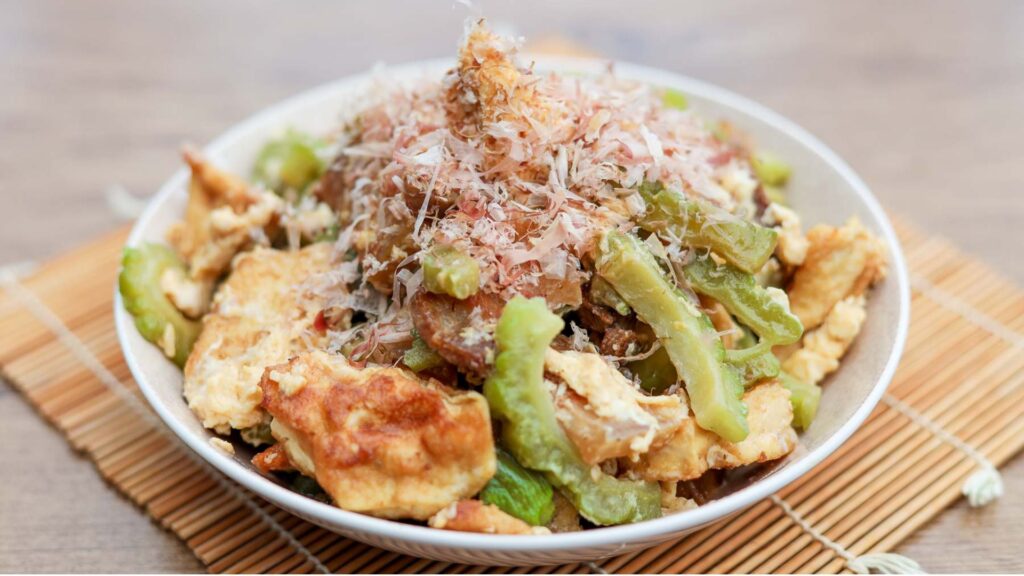
Goya champuru
The dish most associated with Okinawa and the one most directly connected to the longevity culture. Champuru means “something mixed together” in the Okinawan language, and the champuru family of stir-fries extends across many ingredient combinations, tofu champuru, papaya champuru, fu (wheat gluten) champuru, but goya champuru, made with bitter melon, is the definitive version.
The goya (bitter melon) is the ingredient most likely to challenge first-time visitors. Its bitterness is genuine and initial, the first bite registers strongly, before giving way to a clean, almost cooling quality that makes it refreshing rather than unpleasant once the palate adjusts. Locals describe it as an acquired appreciation rather than an acquired taste; the bitterness is the point, not a flaw. It is believed in Okinawan food culture to have cooling properties that make it particularly valuable in the subtropical summer heat.
Order it at any traditional Okinawan restaurant in Naha. Mikado and Hanare in Naha are consistently recommended by locals for the most authentic versions. Eat it with rice and miso soup as part of a set meal.
Okinawa soba
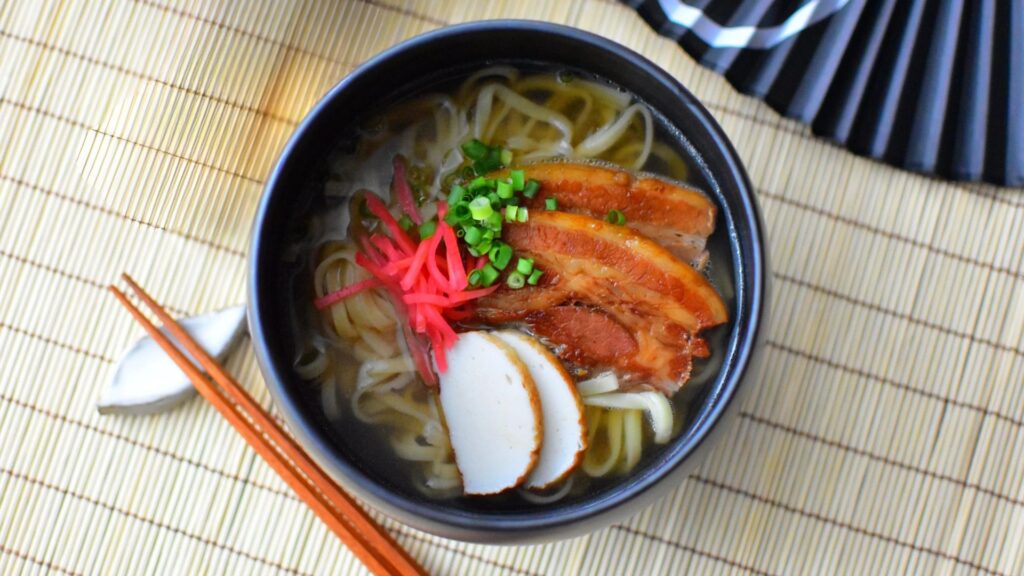
Not buckwheat noodles in the mainland Japanese sense, Okinawa soba is a wheat noodle, thicker and chewier than ramen, served in a clear broth made from pork bone and bonito with toppings of rafute (braised pork belly), soki (spare ribs), fish cake, and pickled ginger. The broth is cleaner and less rich than ramen, the noodles more substantial than a delicate bowl of mainland soba, and the overall effect is deeply satisfying without being heavy.
Hirayachi pepper, a small dried berry used as a traditional Okinawan spice with a warm, complex flavour somewhere between black pepper and Szechuan peppercorn, is kept on tables at traditional soba shops as a seasoning. Add it after the first few mouthfuls when the base flavour of the broth is established.
Hamabe no Chaya in Itoman City, a traditional restaurant overlooking the ocean, is considered one of the finest soba experiences on the main island, and the combination of the setting and the bowl is worth the drive from Naha. In Naha itself, Yunangi is consistently recommended for soba and traditional Okinawan set meals.
Rafute
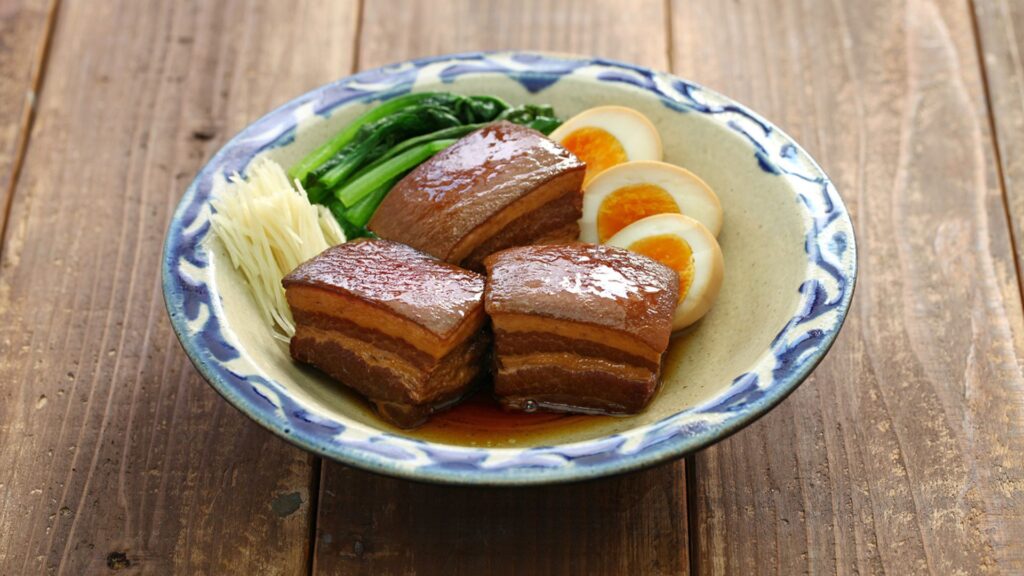
Braised pork belly slow-cooked in awamori, soy sauce, and brown sugar until the meat is fork-tender, the fat has rendered completely, and the exterior carries a glossy, deeply sweet-savoury glaze. Rafute was originally royal court cuisine, a dish from the Ryukyu Kingdom’s palace kitchen, and the preparation time required still reflects that origin: the best versions cook for several hours, the pork becoming something entirely different from its starting point.
Every restaurant and every home kitchen has its own proportions of awamori to soy to sugar, and the variation across different versions is significant. This is worth ordering at multiple restaurants across the trip precisely because of that variation.
Taco rice
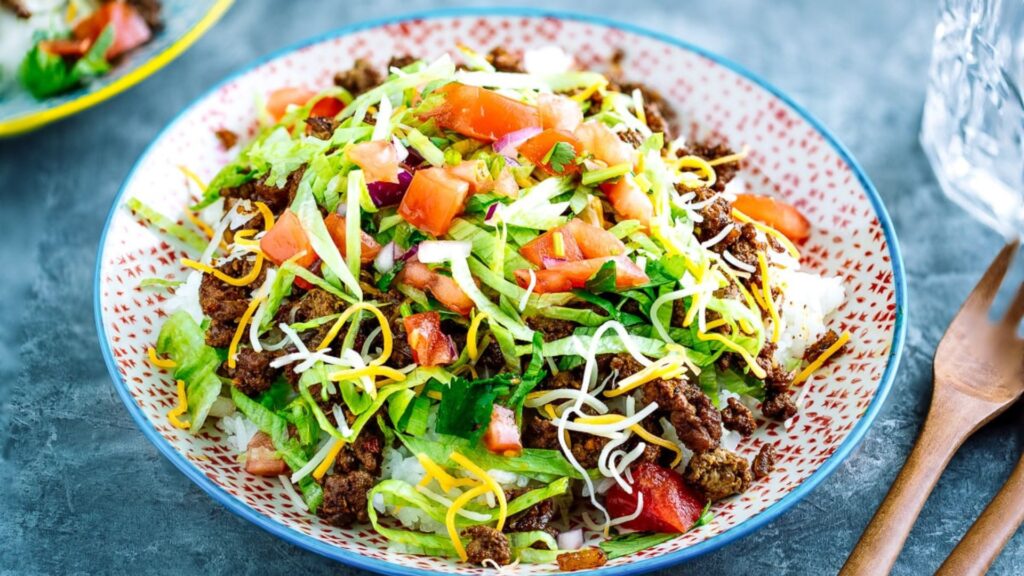
One of those dishes that should not work and undeniably does. Tex-Mex seasoned ground beef, shredded lettuce, diced tomato, and cheese on a bed of Japanese rice, with salsa served alongside, invented in a restaurant near a US military base in Koza City in 1984 and now eaten across the island by locals who consider it as Okinawan as goya champuru. The original restaurant, Parlor Senri in Koza, still exists and serves the dish in its original form.
The cultural history embedded in a plate of taco rice, the American military, the post-war period, the hybrid identity that defines contemporary Okinawa, makes it more interesting than it looks. Order it at least once, ideally at the original location.
Umibudo (sea grapes)
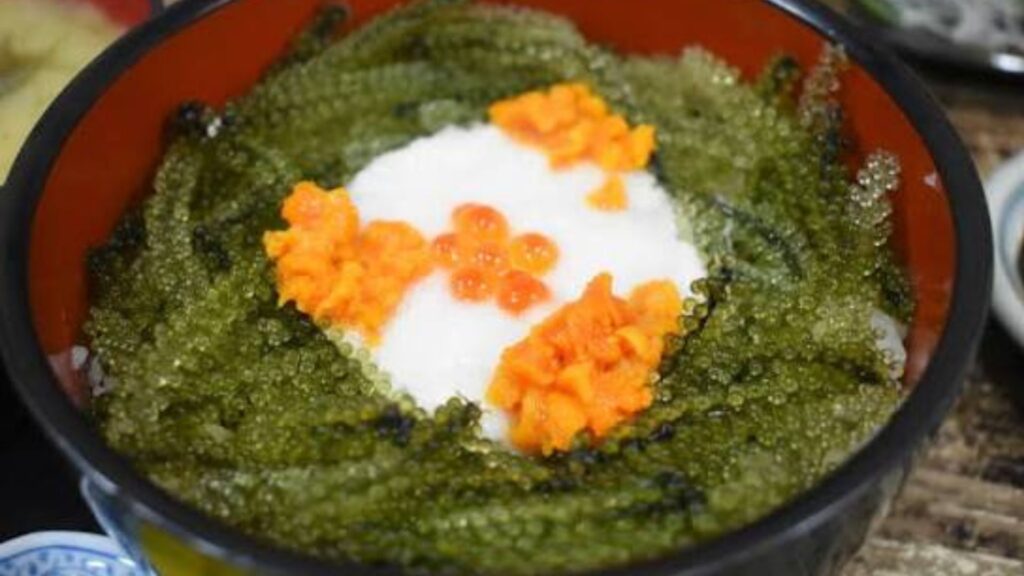
Okinawa’s most visually distinctive ingredient and the one most likely to produce visible delight at the table. Umibudo, “sea grapes” in Japanese, though they are technically a type of seaweed called Caulerpa lentillifera, are clusters of tiny, translucent green spheres on thin stems that burst gently in the mouth and release a clean, briny flavour that tastes precisely of the ocean in the best possible sense. They are grown in the warm subtropical waters around Okinawa and served as a side dish or salad topping across the islands.
They are also almost entirely unavailable outside Okinawa in fresh form, which makes eating them here a genuinely place-specific experience. Order them every time they appear on a menu.
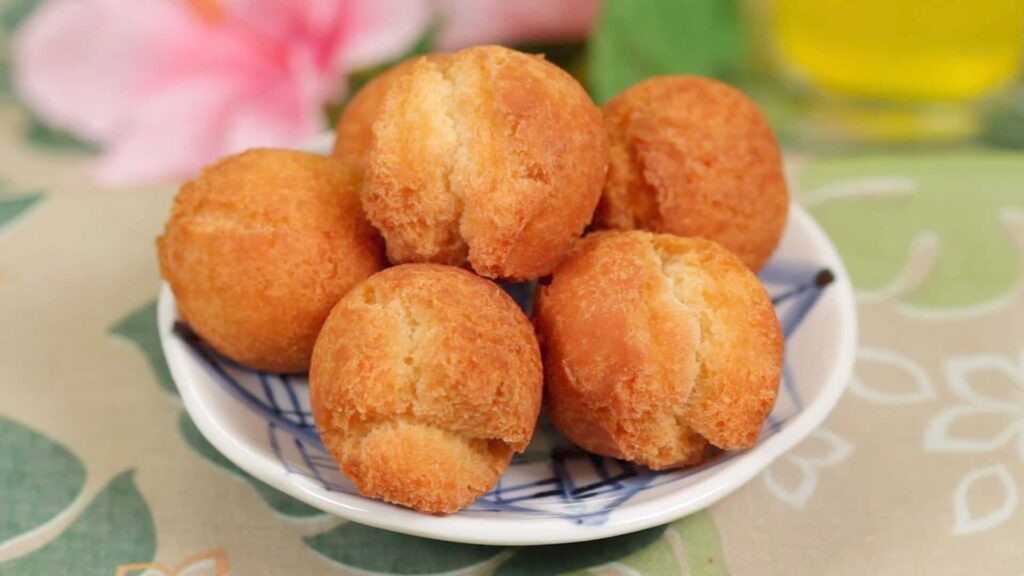
Sata andagi
Okinawa’s most beloved street food and the one most likely to cause a minor addiction. A deep-fried doughnut made from flour, eggs, sugar, and baking powder, with a crunchy golden exterior and a soft, slightly dense interior, sata andagi are sold from market stalls, roadside shops, and the Makishi Public Market throughout Naha. The brown sugar version is the finest. They are best eaten immediately, still warm, standing in the market.
Inamuruchi
A dish from the royal cuisine of the Ryukyu Kingdom that appears at traditional restaurants and on festive occasions, a clear white miso soup containing pork, shiitake mushrooms, fish cake, and konbu seaweed, slow-simmered until the flavours meld completely. The name derives from “ina” (wild boar) and “muruchi” (imitation), it was originally a substitute for wild boar using pork, developed for royal banquets when boar was unavailable. It is one of the most historically layered dishes in Okinawan cooking and worth ordering at any restaurant that includes it on the menu.
Hirayachi
A savoury pancake unique to Okinawa, thinner than Japanese okonomiyaki, made from eggs, flour, green onion, and salt, served with a dipping sauce of soy, vinegar and sesame oil. Hirayachi was historically an emergency food, simple ingredients, cooked on a portable stove during the storms and typhoons that are a recurring feature of Okinawan life. It is now simply a beloved everyday dish. Try it at Chonchon or Okinawa Dining Hateruma in Naha.
The drinks
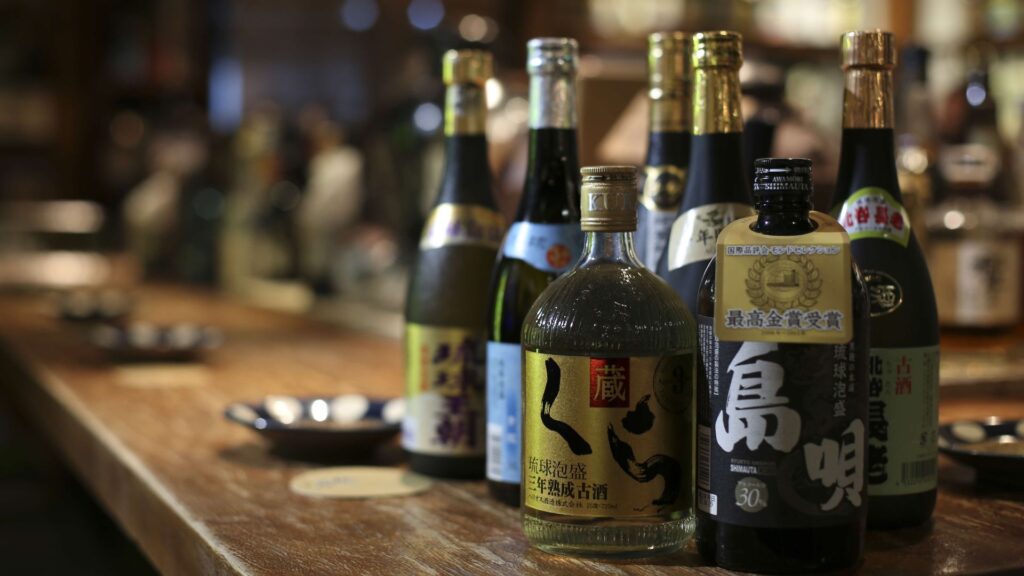
Awamori
Okinawa’s own spirit and one of the most distinctive alcoholic drinks in Japan. Unlike mainland Japanese sake, which is brewed from Japanese short-grain rice, awamori is distilled from Thai long-grain rice using black koji mold, producing a clear spirit that is typically 30 percent alcohol or higher and carries a clean, slightly earthy flavour that becomes more complex with age.
The finest aged awamori, kusu, matured in clay pots for a minimum of three years, sometimes for decades, develops a depth and smoothness that places it in the category of aged spirits worth serious attention. The aging in clay rather than wood means the flavour development is different from whisky or brandy, the earthiness of the pot is part of the character of the spirit in a way that no barrel-aged product replicates.
Awamori is drunk diluted with water (mizuwari) or on the rocks (on the rocks with ice is called on the rocks in the local izakaya), or served neat for the finest kusu versions. Distillery tours are available at several producers on the main island, Zuisen Distillery near Shuri Castle is the most accessible and offers tastings alongside a tour of the koji and distillation process.
The koregusu condiment found on tables at many Okinawan restaurants, small chili peppers steeped in awamori, is the island’s signature seasoning for soba and champuru, and one of those flavour additions that immediately makes every dish more interesting.
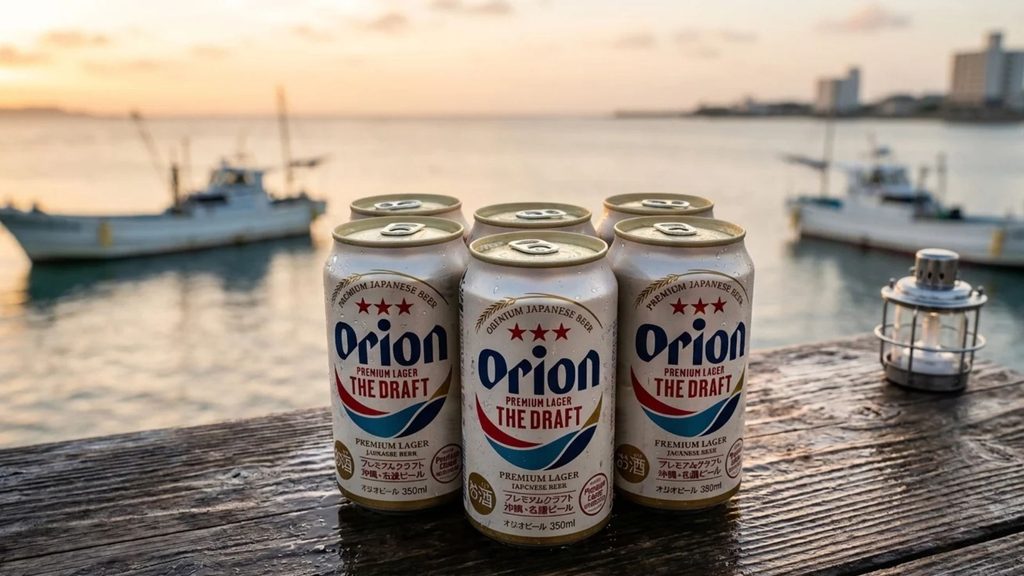
Orion Beer
Okinawa’s own lager, brewed in Nago City on the main island since 1957, and the correct accompaniment to almost everything on this list. It is light, clean, slightly sweet, and considerably more refreshing in subtropical heat than any imported alternative. It is also, at the izakayas of Naha’s Tsuboya neighbourhood and the beach bars of the outer islands, the beer that appears in almost every hand. Order it cold. There is no other way.
Shikuwasa juice
A small citrus fruit unique to the northern forests of Okinawa’s main island, shikuwasa (Citrus depressa) is tart, complex, and extraordinarily fragrant, somewhere between a lime and a mandarin, with a flavour that has no equivalent in Western citrus. It is squeezed over sashimi, mixed into awamori cocktails, and drunk as a fresh-squeezed juice at market stalls throughout Naha. Research has identified the nobiletin compound in shikuwasa as one of the potential contributors to Okinawan longevity. The juice is simply delicious.
The longevity diet: what the centenarians actually eat
The Blue Zone research on Okinawan longevity has produced extensive documentation of what the island’s oldest residents eat daily, and the contrast with Western dietary patterns is instructive.
The traditional Okinawan diet is approximately 85 percent plant-based. Sweet potato historically provided 60 percent of caloric intake, not polished white rice, which arrived later. Green and yellow vegetables appear at every meal. Soy foods, tofu, miso, edamame, are consumed daily. Fish is eaten several times per week. Pork appears in small quantities, used as flavouring rather than as a primary protein. Meat overall accounts for approximately 1 percent of caloric intake in the traditional diet.
The longevity restaurant experience near the Churaumi Aquarium on the Motobu Peninsula brings this philosophy directly to visitors. The meal served here mirrors exactly what the centenarians of the northern villages eat daily, a set meal of champuru, miso soup, pickled vegetables, sweet potato, and small portions of fish and tofu, eaten slowly, in the company of others. A short documentary made with eight grandmothers nearing 100 plays before the meal, providing context. It is the most direct encounter with the longevity food philosophy available to visitors and one of the more genuinely unusual dining experiences in Japan.
The markets
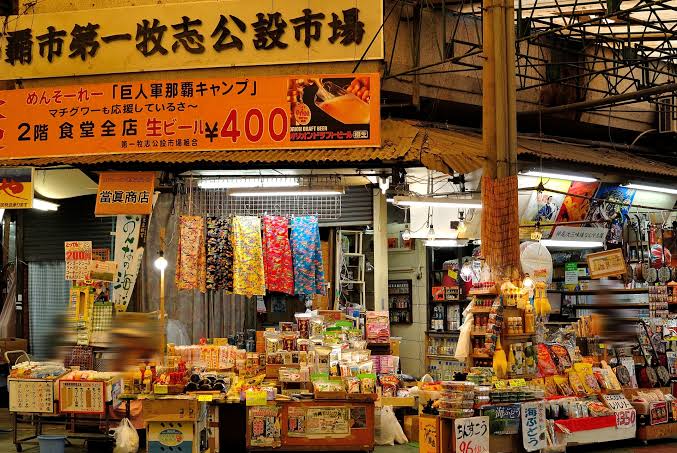
Makishi Public Market, Naha
The food heart of Naha and the essential first morning stop for any serious food traveller. The ground floor of the covered Makishi market is one of the most extraordinary market fish sections in Japan, vendors selling tropical fish, shellfish, sea snakes, sea turtles (legally farmed), and the espada-like deep-sea fish that appear in Okinawan cooking in colours and forms that have no equivalent in temperate water fish markets. Take the stairs to the second floor, where a series of small restaurants will cook whatever you purchase downstairs for a modest preparation fee, an arrangement called “bring your own fish” that produces some of the most direct, freshest seafood eating available in Okinawa.
Sata andagi vendors occupy the market entrance and side streets. Buy several. Sea grapes appear at multiple stalls. The entire market takes 45 minutes to walk through properly and two hours to experience properly.
Farmers’ markets: Itoman and Tomishiro
Outside Naha, the agricultural markets of southern Okinawa, particularly at Itoman City and Tomishiro, give the most complete picture of what Okinawan produce actually is before it reaches a restaurant kitchen. Island vegetables, tropical fruit, goya in season, fresh shikuwasa, turmeric root, and the bitter herbs used in champuru and medicinal preparations are all available at prices that reflect a local rather than tourist market. Worth a visit on a half-day to the south of the main island.
The restaurants
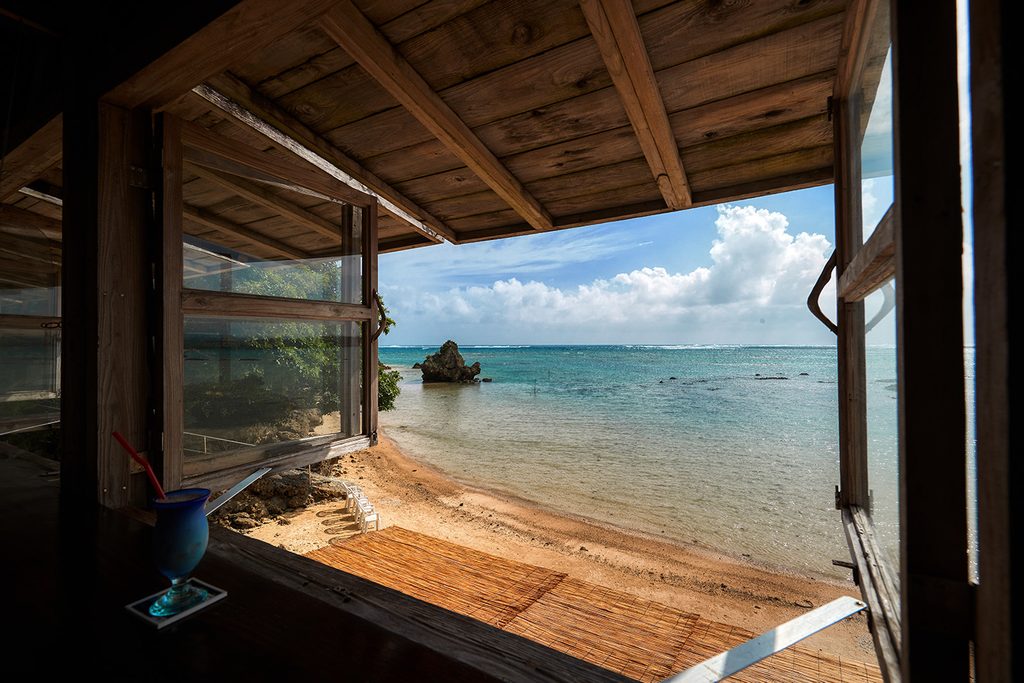
Hamabe no Chaya, Itoman City
A traditional thatched-roof restaurant overlooking the ocean in the south of the main island, considered by many food-focused visitors to serve the finest Okinawa soba on the main island. The setting, a low wooden building open to the sea breeze with tatami seating and the ocean visible through every window, makes the meal an experience of place as much as an experience of food. The soba broth here is particularly good: clean, deep, and clearly made from scratch rather than from commercial stock. Worth the 30-minute drive from Naha.
Yunangi, Naha
A traditional Okinawan restaurant in central Naha that consistently receives the highest recommendations from food-focused visitors for the quality of its set meals. The menu covers the essential dishes, goya champuru, Okinawa soba, rafute, soki, alongside less commonly found dishes like inamuruchi and the full range of champuru variations. The interior is warm and traditional, the portions generous, and the set meal format the most efficient way to cover the greatest range of Okinawan food in a single sitting.
Parlor Senri, Koza City
The original home of taco rice, the restaurant where the dish was invented in 1984, still operating in its original location near the US military base in Koza. The cultural experience of eating the original taco rice in the restaurant that invented it, in a city shaped by the American military presence more visibly than anywhere else on the island, is the correct context for understanding what this dish actually represents. The taco rice is also, genuinely, very good.
Ryukyu Cuisine Minsa, Naha
One of the finest restaurants in Naha for traditional Ryukyuan court cuisine, the dishes developed for the royal palace of the Ryukyu Kingdom that form the most historically layered and elaborate tier of Okinawan food culture. Rafute prepared in the classical manner, inamuruchi, and dishes using ingredients and preparation methods that survived the annexation in the culinary tradition if not always in the historical record. Course meals are available for dinner, book in advance, particularly during peak season.
Izakayas of Tsuboya and Makishi
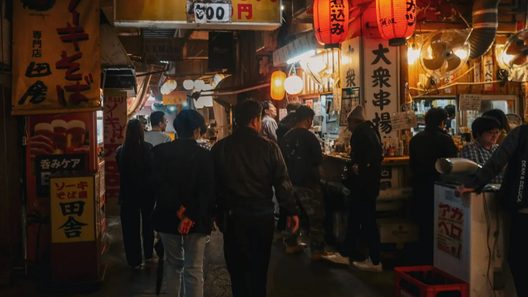
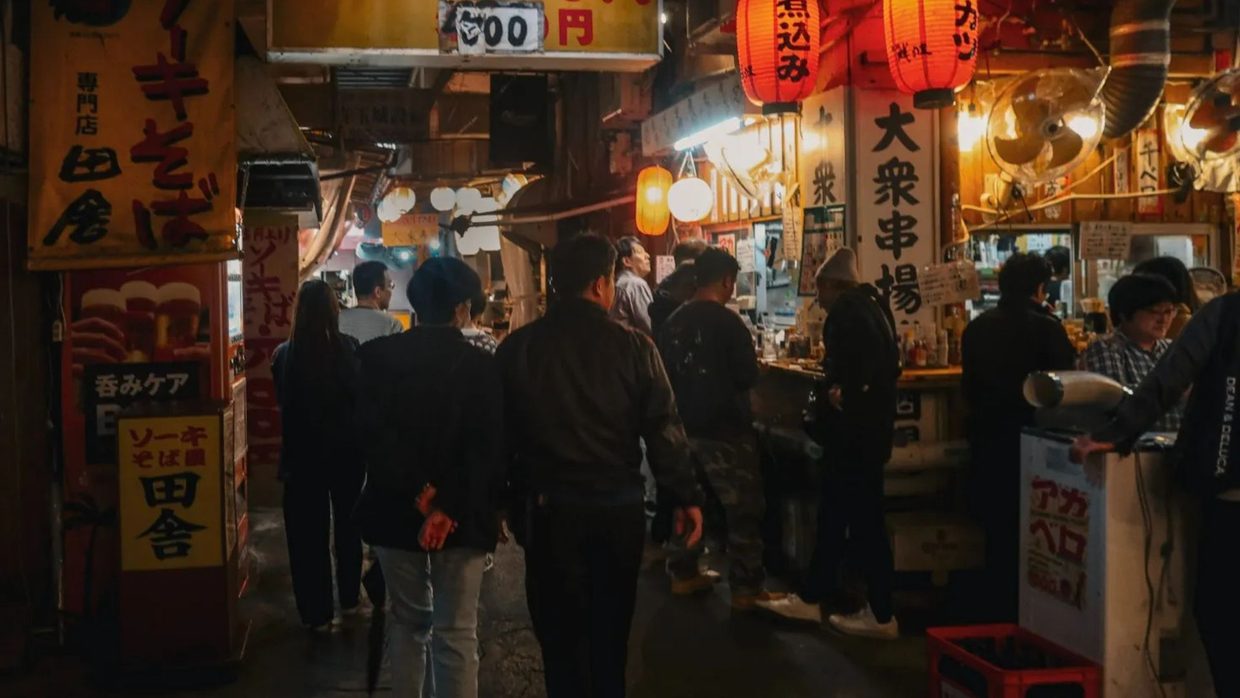
The neighbourhood izakayas around the Tsuboya pottery district and the streets near Makishi Market are the most reliable destination for the informal, social, sharing-dishes version of Okinawan dining that the longevity research describes, multiple small dishes ordered across the course of a long evening, awamori or Orion beer flowing steadily, the meal functioning as a social event rather than a feeding exercise. No single izakaya stands above the others. Walk the streets of Tsuboya in the early evening and follow the one that looks most full of locals.
Blue Zone longevity restaurant, Motobu Peninsula
Near the Churaumi Aquarium in the north of the main island, this experience, more structured cultural encounter than conventional restaurant, serves the longevity diet meal as described above, preceded by the documentary featuring the island’s centenarians. It is not the finest food on this list. It is the most interesting context in which to eat Okinawan food. For visitors whose interest in Okinawa includes the Blue Zone dimension as well as the beaches and the culture, it is essential.
A day of eating in Okinawa
Breakfast: Okinawa soba at a local noodle shop, soki soba, with spare ribs, at 08:00 when the shops open and the broth is freshest.
Mid-morning: Makishi Public Market. Sea grapes at a stall. Sata andagi from the entrance vendors. Coffee from a market-side cafe.
Lunch: Goya champuru set meal at Yunangi or a local shokudo (diner), rice, miso soup, pickled vegetables, champuru.
Afternoon: Shikuwasa juice from a market vendor or convenience store. Beni-imo (purple sweet potato) soft serve ice cream, available throughout Naha and at roadside stalls across the island.
Pre-dinner: Awamori at an izakaya, start with a diluted mizuwari of a standard awamori, then try a kusu if the izakaya carries one.
Dinner: Rafute and assorted dishes at a Ryukyu cuisine restaurant, ordered as sharing dishes across the table, eaten slowly, over two hours.
Practical notes
Language: Most restaurants outside the main tourist areas of Naha have menus in Japanese only. A photo menu is common, point and order. Google Translate’s camera function handles most menus adequately. The Makishi Market vendors are experienced with international visitors and communication is rarely a problem.
Meal times: Okinawa follows mainland Japanese meal timing, lunch from 11:30 to 14:00, dinner from 17:30 to 21:00. Many traditional restaurants outside Naha close earlier than the tourist-oriented places in the city centre. Do not leave dinner until 22:00 outside central Naha.
Vegetarian and vegan: Okinawan food is challenging for strict vegetarians, pork appears in the broth of many dishes including Okinawa soba, and champuru typically includes meat or Spam. Several restaurants in Naha offer vegan versions of champuru using a soy-based broth, but it requires specific enquiry. The Makishi Market sea grape stalls are reliable for plant-based eating.
Budget: Okinawan food is excellent value by Japanese standards. A soba set meal costs 800 to 1,200 yen. A champuru set meal is similar. Izakaya dining runs 2,000 to 4,000 yen per person with drinks. The Ryukyu cuisine course meals at higher-end restaurants cost 5,000 to 10,000 yen per person.
The complete Okinawa series
Everything you need to go properly:
- Okinawa: the complete guide – what it is, where it is, the history, the Blue Zone, the full 10-day itinerary
- The beaches and waters of Okinawa – Kerama Blue, Miyako’s finest beach in Japan, Ishigaki’s manta rays, the Blue Cave
- Eating in Okinawa – champuru, soba, sea grapes, awamori, the longevity diet and where to experience it
- Where to stay in Okinawa – Hyakuna Garan’s Michelin Key clifftop ryokan to Kerama Island guesthouses
- The best tours and activities – humpback whale watching, Manta Scramble, Iriomote kayaking, the Phantom Island
- The outer islands – Kerama, Miyako, Yaeyama, Yonaguni and the mystery on the ocean floor
- Why Okinawa is the most extraordinary island group in Asia – the editorial case
Some links in this post are affiliate links. If you book through them, flight.now earns a small commission at no extra cost to you. Learn more here