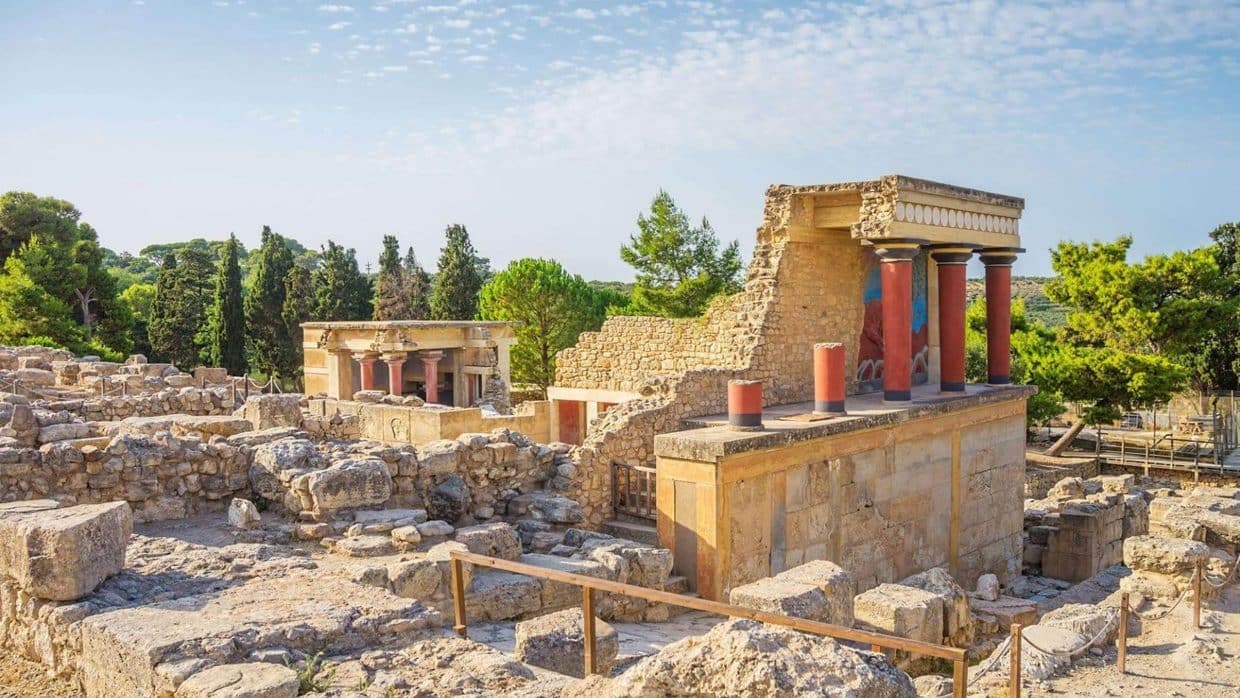
Crete is not an island in the way that Santorini or Rhodes are islands. It is a country that happens to be surrounded by water. At 260 kilometres from west to east and 8,336 square kilometres in total, it is the fifth largest island in the Mediterranean and large enough to sustain mountain ranges, gorges, ancient civilisations, distinct regional food cultures, and enough coastline variation that two travellers can spend a week on the same island in completely different landscapes without overlapping.
The Minoans built Europe’s first advanced civilisation here four thousand years ago – a palace culture of extraordinary sophistication that predated classical Greece by a millennium and left ruins at Knossos and Phaistos that are among the most significant archaeological sites on the continent. The White Mountains in the west reach 2,452 metres and remain snowcapped into June. The gorge that cuts through them is the longest in Europe. The south coast, facing Africa across the Libyan Sea, has villages accessible only by boat or on foot, where the pace of life has not meaningfully changed in decades. The food is unlike anything else in Greece.
A week is the minimum. Ten days is the honest recommendation. Two weeks reveals an island that most visitors have never seen.
Where to base yourself
Crete’s size means the decision of where to stay shapes the experience more than almost any other Greek island. The island divides broadly into four regions, each with a different character and access to different experiences.
Chania
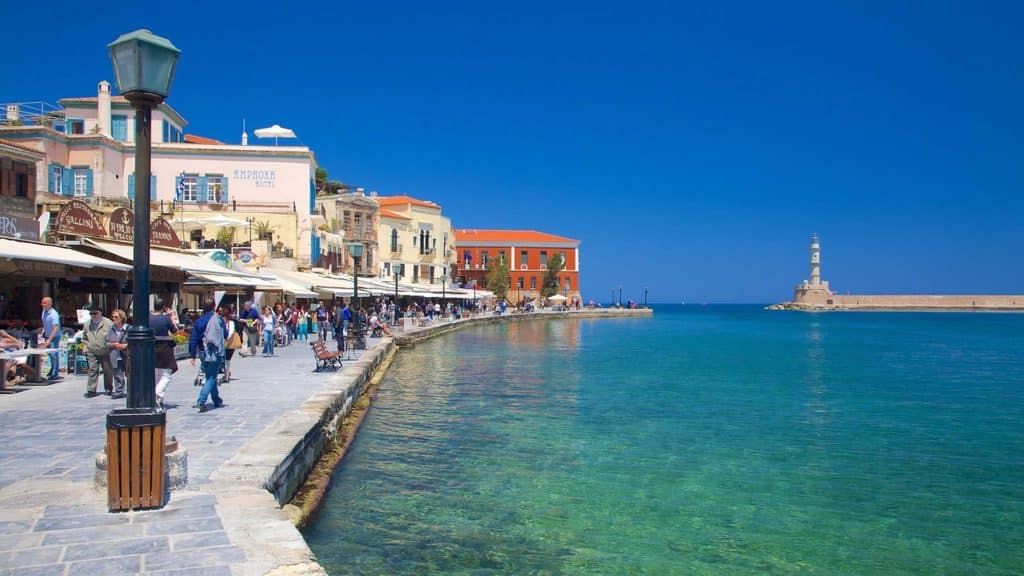
The most beautiful city in Crete and the best base for first-time visitors. The Venetian harbour – a crescent of 14th-century buildings, a lighthouse the Venetians built and the Ottomans later rebuilt, the covered market of the 1911 Agora, the narrow lanes of the Splantzia quarter where Ottoman mosques sit alongside Venetian architecture and traditional kafeneions – is the finest urban environment on the island. Within reasonable driving distance of Balos Lagoon (45 kilometres), Elafonissi Beach (75 kilometres), and the Samaria Gorge trailhead (42 kilometres). Chania also has its own airport (CHQ), making it possible to fly directly here without routing through Heraklion.
Accommodation ranges from budget rooms in the old town to harbour-view boutique hotels at 200 to 300 euros per night in peak season. Stay inside the old walls for evening access to the harbour restaurants without a taxi.
Rethymno
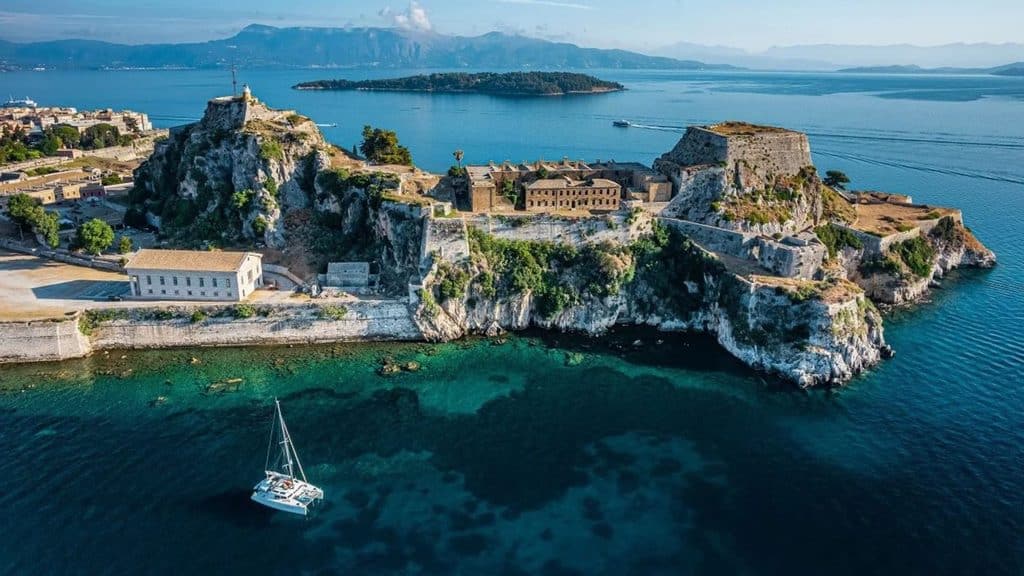
The quieter, less visited alternative to Chania, with its own Venetian fortress (the Fortezza, the largest in Crete), its own old town of narrow Ottoman-era streets, and a long sandy beach directly in the city. Rethymno is the most complete Venetian town in Crete – more intact than Chania, less visited, and carrying an atmosphere of genuine daily life that the more tourist-oriented Chania harbour occasionally obscures. Good access to the south coast village of Preveli and to the Cretan highlands.
Heraklion
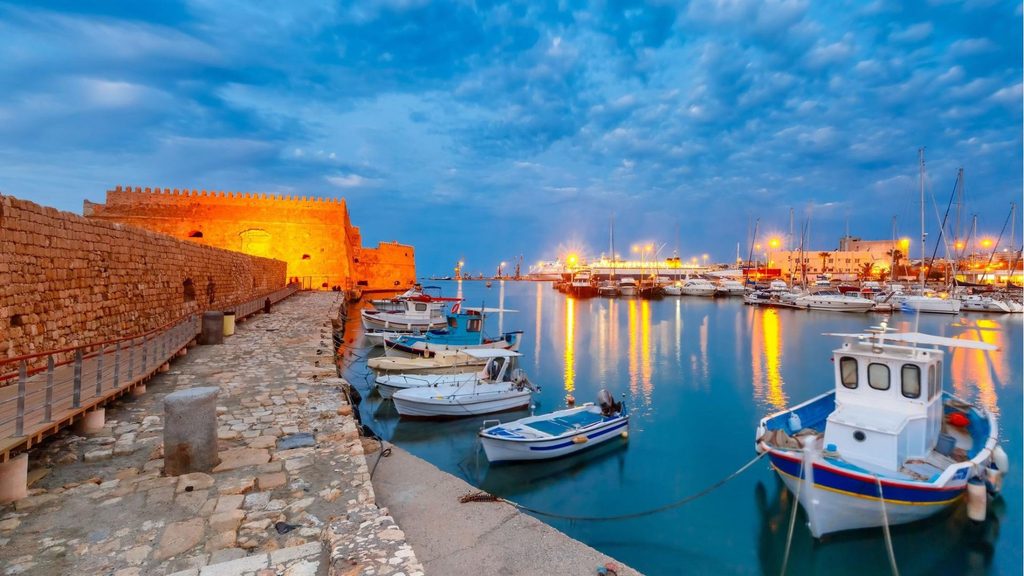
The capital and practical rather than picturesque. Heraklion’s strengths are the Archaeological Museum – which holds the finest collection of Minoan artefacts in the world and is essential context for the Knossos visit – and the proximity to Knossos itself, fifteen minutes away. The city’s food and restaurant scene has developed significantly in recent years and is now among the most interesting on the island. A base in Heraklion makes sense for the history-focused itinerary; for everything else, Chania or Rethymno.
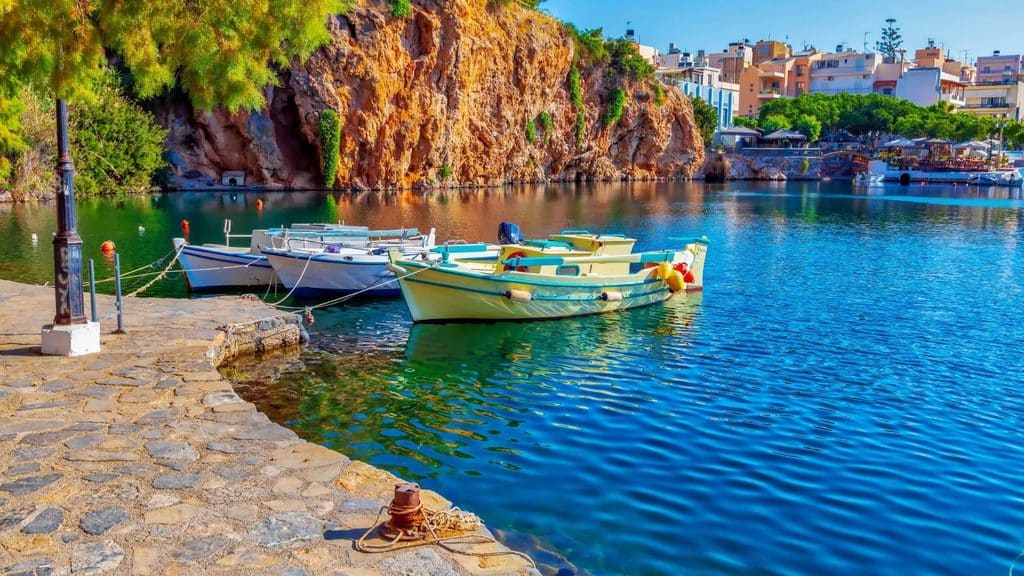
East Crete – Agios Nikolaos, Elounda, Sitia
The quietest and least visited region of the island, with the most upscale resort infrastructure at Elounda and some of the emptiest beaches available anywhere on Crete at the eastern tip. The island of Spinalonga, a former Venetian fortress and, in the early 20th century, one of Europe’s last active leprosy colonies, is accessible by short ferry from Elounda and is among the most affecting historical sites on the island. East Crete rewards the visitor with time and a preference for seclusion over atmosphere.
The Minoan civilisation: what to see
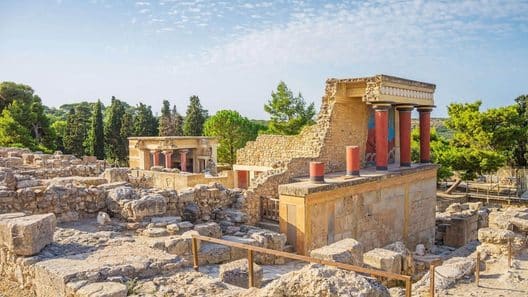
Palace of Knossos
The most significant Bronze Age site in Europe and the correct starting point for understanding what Crete is. Knossos was the centre of the Minoan civilisation, Europe’s first advanced society, which flourished between approximately 2000 and 1400 BC. The palace complex – with its 1,300 rooms, its plumbing system, its frescoed walls, its central court – was a feat of engineering and culture that predated the Acropolis in Athens by fifteen centuries.
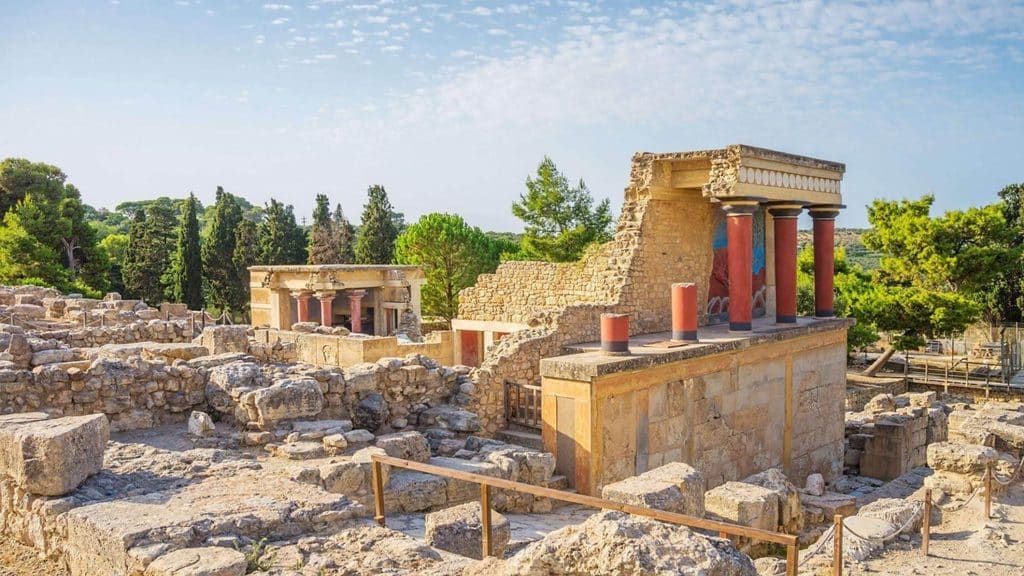
The archaeologist Arthur Evans excavated and partially reconstructed the site in the early 1900s, a decision that has divided archaeologists ever since – the reconstruction gives visitors a sense of the palace’s scale and character that bare ruins cannot provide, but it also layers Evans’s interpretation onto a site whose true appearance remains debated. The frescoes displayed at the site are reproductions; the originals are in the Heraklion Archaeological Museum.
Entry 18 euros. Combined ticket with the Archaeological Museum 25 euros – worth it. Arrive at 08:00 when the site opens to avoid the cruise ship tour groups that arrive between 10:00 and 14:00. Hire a guide on arrival – Knossos makes significantly more sense with expert context than without it.
Heraklion Archaeological Museum
The most important Minoan collection in the world, housed in a purpose-built museum in central Heraklion.
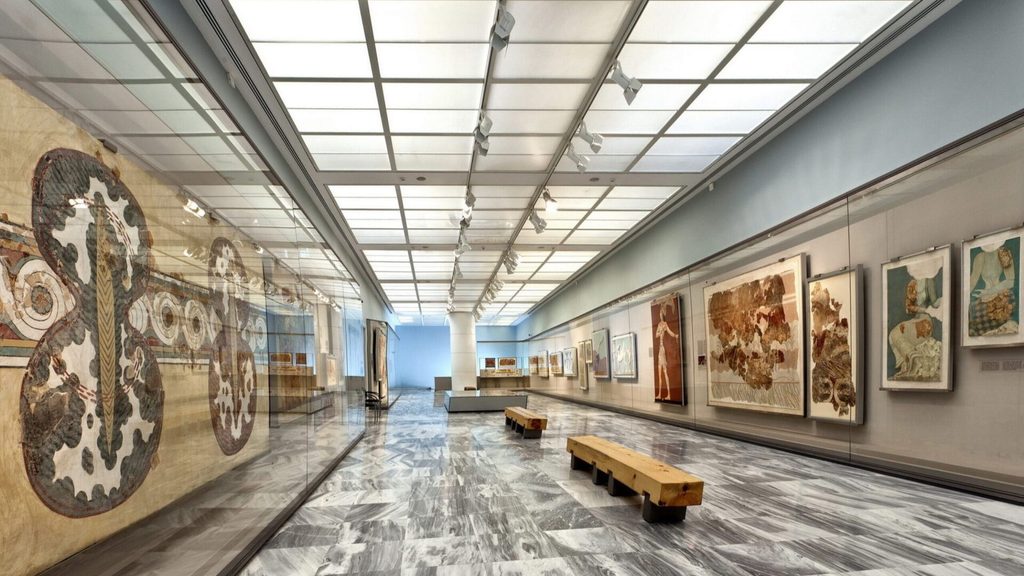
The Snake Goddess figurines, the Bull-Leaping Fresco, the Phaistos Disc (an undeciphered Bronze Age document whose script has not been solved despite a century of scholarship), the gold jewellery, the painted sarcophagi – the collection is extraordinary and the museum’s presentation is among the finest in Greece. Allow three hours minimum.
Phaistos and Agia Triada
The second great Minoan palace on the island, on a hilltop in the Messara Plain in the south of the island with views across the valley toward the Libyan Sea.
Less reconstructed than Knossos and consequently harder to interpret without knowledge, but more atmospheric in its setting and significantly less visited. Agia Triada, two kilometres away, is a smaller Minoan villa that was excavated in the early 20th century and contains extraordinary frescoes. Together they constitute a full day of Minoan archaeology in a setting of genuine beauty.
The Samaria Gorge
The Samaria Gorge is one of Europe’s longest ravines – 16 kilometres of path descending from the Omalos plateau in the White Mountains to the village of Agia Roumeli on the Libyan Sea coast. The hike takes five to seven hours for most visitors, descending approximately 1,250 metres in elevation, through terrain that moves from mountain pine forest to the famous Iron Gates – a 300-metre section where the gorge narrows to three metres wide and the cliff walls rise to 600 metres above – to the Mediterranean scrubland at the coast.
The gorge is a UNESCO Biosphere Reserve and part of the Samaria National Park. It is open seasonally from May to October – winter rains and rockfall make it unsafe outside this window. The kri-kri – a wild goat found only in Crete and a few offshore islands – is occasionally spotted on the upper rocky sections.
The standard approach: drive or take a bus to the Omalos plateau, descend the gorge to Agia Roumeli (no road access), take the ferry from Agia Roumeli along the south coast to Hora Sfakion or Sougia, and return to Chania by road. The logistics require planning – the ferry departure times from Agia Roumeli are fixed and missing the last boat means an overnight in the village. The full circuit from Chania and back is a full day.
Entry 5 euros. Go on a weekday rather than a weekend to reduce the volume of people on the trail – the gorge is popular enough that peak summer weekends produce genuine congestion at the Iron Gates.
The south coast
The south coast of Crete faces Africa across the Libyan Sea and is a completely different island from the north coast resort strip. The mountains descend directly to the water in most sections, the road access is limited, and the villages that exist here have been shaped by isolation in ways the north coast has not.
Loutro – accessible only by ferry or on foot, with no road access, Loutro is a small horseshoe bay of white-washed buildings above a clear blue harbour where the fishing boats are the main traffic. There are no cars. The pace is what pace looks like when it has nowhere to go. Several tavernas serve the catch from the morning boats. Ferries run from Hora Sfakion (fifteen minutes) and from Agia Roumeli after the gorge exit. Stay overnight in one of the small guesthouses above the harbour and experience the south coast as it was before tourism arrived on the north.
Paleochora – the most developed south coast village and the one with the best infrastructure for longer stays. A thin peninsula with a sandy beach on one side and a pebble beach on the other, a Venetian castle ruin above the town, and a collection of tavernas and bars that operate at the pace the south coast imposes. Ferry connections run along the south coast to Loutro, Hora Sfakion, and west to the island of Gavdos – the southernmost point of Europe.
Preveli Beach – one of the most distinctive and photographed beaches in Crete. A river descends from the Cretan highlands through a palm-lined canyon to the Libyan Sea, creating a freshwater lagoon at the beach level before the river meets the sea. The palm grove – one of only two natural palm groves in Europe – was deposited by the Nile current over centuries and is unlike any other landscape in Greece. Access is via a steep fifteen-minute descent on foot from the upper car park. No facilities at beach level.
Matala – famous for the Roman-era cave dwellings in the cliff face above the beach that were occupied by hippies in the 1960s and 70s and attracted Joni Mitchell and Cat Stevens among others. The caves are now open as a paid archaeological site (entry 3 euros). The beach is wide, sandy, and warm, and the village behind it has a relaxed bohemian atmosphere that is lighter than the north coast resort towns.
The beaches
Crete has over 1,000 kilometres of coastline and beach quality that ranges from the extraordinary to the ordinary. The extraordinary ones:
Elafonissi – a shallow lagoon at the island’s southwestern tip where the sand is faintly pink from crushed coral and shells, the water is warm and ankle-deep for two hundred metres in every direction, and the small island of Elafonissi is connected to the shore by a sandbar at low tide. It is one of the most distinctive natural beach environments in the Mediterranean. It is also very popular – go early in the morning before the buses from Chania arrive.
Balos Lagoon – reached by a four-kilometre dirt road from the Gramvousa Peninsula in the northwest, or by boat tour from Kissamos harbour, Balos is a lagoon of extraordinary turquoise and white where three bodies of water meet: the Mediterranean, the Cretan Sea, and the Libyan Sea. The walk from the car park to the beach takes twenty minutes. The view from the ridge above the lagoon before the descent is one of the most spectacular coastal panoramas in Crete.
Falassarna – a long, wide, west-facing beach of golden sand in the northwestern corner of the island, considered by many visitors to have the finest sunsets in Crete. Less visited than Elafonissi and Balos. Several beach bars operate but the scale of the beach means it absorbs volume well.
Vai – Europe’s largest natural palm grove, on the eastern tip of the island, with a beach backed by the same Nile-current palm trees that appear at Preveli. The eastern location means it is significantly less visited than the west coast beaches.
Food
Cretan food is the most specific regional cuisine in Greece and the one most directly connected to the concept of the Mediterranean diet. The Cretan diet – high in olive oil, legumes, vegetables, and wild greens, low in meat, built around what the island’s extraordinary agricultural environment produces – was one of the foundational reference points for Ancel Keys’ original Mediterranean diet research in the 1960s. The longevity of the Cretan population in that period, and the food culture that produced it, is still visible in the village kitchens of the island’s interior.
Dakos – the essential Cretan starter. A dried barley rusk (paximadi) soaked briefly in water to soften, topped with grated fresh tomato, crumbled mizithra cheese, Cretan olive oil, and dried oregano. Simple, specific to Crete, and better than it sounds by a significant margin. Order it everywhere.
Staka – a cooked cream made from the fat skimmed from sheep’s milk, traditionally served with fried eggs as a rich breakfast or mezedes dish. Found primarily in village tavernas and traditional restaurants rather than tourist-facing menus.
Apaki – smoked pork, marinated in wine vinegar and aromatic mountain herbs before smoking. The smoking process produces a product quite different from any mainland Greek equivalent – drier, more intensely flavoured, and uniquely Cretan.
Boureki – a baked pie of courgette, potato, and mizithra cheese, specific to the Chania region. The combination sounds simple and tastes extraordinary.
Cretan raki (tsikoudia) – the island’s spirit, distilled from the grape skins and stems remaining after winemaking, served ice cold in small glasses at the end of every meal whether you ordered it or not. It arrives unbidden, with a piece of fruit or a small sweet, and to decline it is to decline Cretan hospitality in its most essential form.
Where to eat: The village tavernas of the interior – in Anogeia, Spili, Axos, and the villages of the Apokoronas area – serve the most traditional Cretan food at prices that reflect local rather than tourist economics. Chania’s old town has good food at restaurant prices; the market street of Skridlof has cheaper, more genuine options. On the south coast, the fish tavernas of Loutro, Paleochora, and Hora Sfakion serve the morning catch grilled simply with olive oil and lemon in settings where the sea is five metres away.
Where to Stay
Wondering where to base yourself in Crete? Use the map below to compare hotels
A suggested itinerary: 10 days
Days 1-3: Base in Chania. Old town, Venetian harbour, covered market, Splantzia quarter. Day trip to Elafonissi or Balos (choose one – both in the same day is rushed). Evening harbour dinners.
Day 4: Samaria Gorge. Full day. Gorge descent to Agia Roumeli, ferry to Hora Sfakion, road return to Chania.
Days 5-6: Move to Rethymno. Fortezza, old town, Preveli Beach day trip, Cretan highlands drive through Spili and the interior villages.
Days 7-8: Move to Heraklion. Knossos (morning, early), Archaeological Museum (afternoon). Phaistos and Agia Triada day trip.
Day 9: South coast. Drive to Matala or ferry to Loutro. Overnight in a south coast village.
Day 10: Return north. Departure from Heraklion or fly from Chania with an airport transfer.
The Greece series
This post is part of the flight.now Greece series:
- Greece: the complete guide – islands, mainland, when to go, how to get around, and what makes each destination distinct
- Rhodes: the island the Knights built — the medieval walled city, the Acropolis of Lindos, and the beaches most visitors never find
- Santorini: the honest guide – the caldera villages beyond Oia, the volcanic beaches, and the old-vine Assyrtiko wine
- Halkidiki: northern Greece’s best kept secret – Sithonia’s hidden coves, the Mount Athos monastery boat tour, and Aristotle’s birthplace
- Meteora: between earth and sky – six monasteries on 400-metre sandstone pillars, hiking trails, and 130,000 years of human history
Some links in this post are affiliate links. If you book through them, flight.now earns a small commission at no extra cost to you. Learn more here