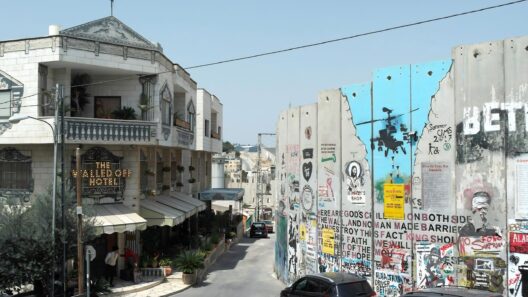
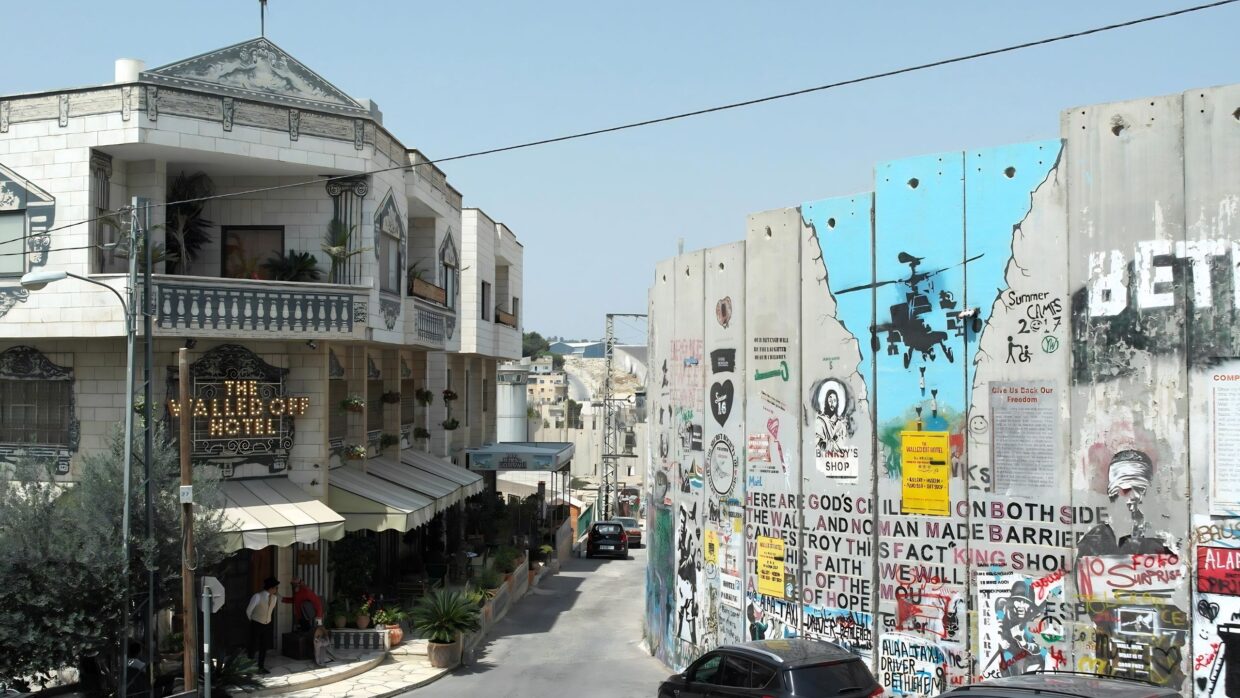
Most hotels sell their view. The Walled Off Hotel in Bethlehem advertises its view as the worst in the world, and then charges you to look at it.
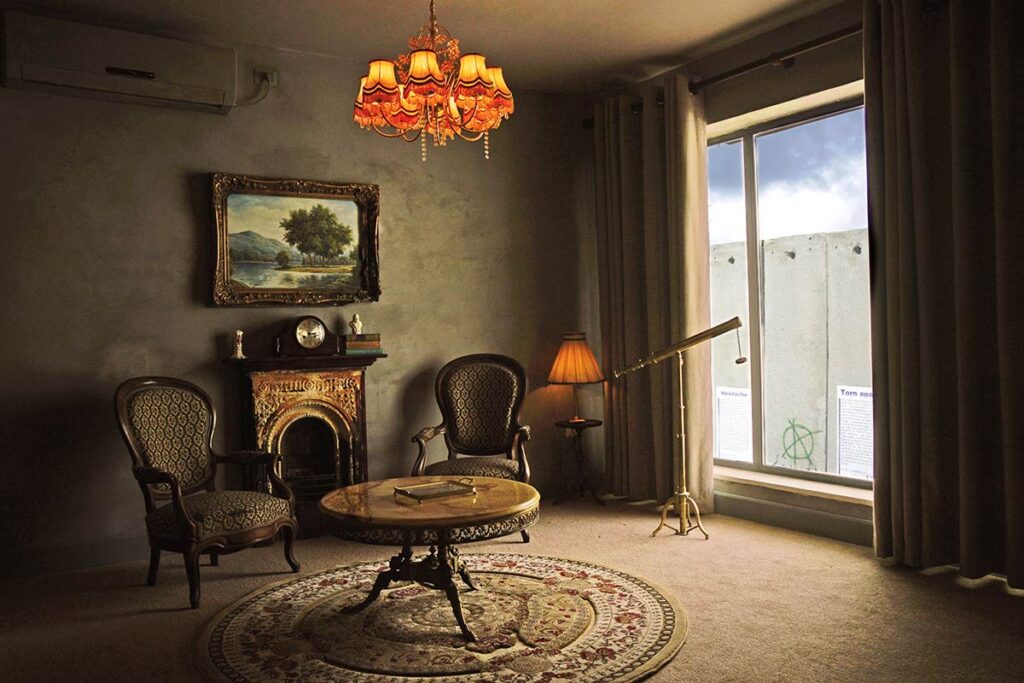
The view in question is the Israeli West Bank barrier: a concrete separation wall up to eight metres tall, covered in political murals, running directly past the front of the building at a distance you could cross in a few seconds. The upper floors of the hotel sit level with the Israeli army watchtowers that overlook it. Some rooms come with complimentary earplugs.
This is not a joke, exactly. It is also, in the particular way that only Banksy operates, completely serious.
The Walled Off Hotel opened in March 2017, took 14 months to build in secret, and is the most ambitious single project the anonymous British street artist has ever created. It is a functioning three-star boutique hotel, a political statement, an immersive art installation, a museum, a gallery, a piano bar, and a bookshop, all occupying one building at 182 Caritas Street, Bethlehem. It describes itself as “a three-storey fight against fanaticism, with breakfast included.”
After closing its doors on October 7, 2023, in response to the outbreak of war in Gaza, the hotel reopened in December 2025. It is operating again in 2026.
Why Banksy built it here
Bethlehem has had a shortage of rooms, Banksy noted at the opening, “famous since biblical times.” The 2017 opening date was also deliberate: it marked exactly one hundred years since the British government issued the Balfour Declaration, expressing support for a Jewish homeland in British-mandate Palestine. Banksy’s statement at the time was characteristically pointed: “It’s exactly one hundred years since Britain took control of Palestine and started re-arranging the furniture with chaotic results. I don’t know why, but it felt like a good time to reflect on what happens when the United Kingdom makes a huge political decision without fully comprehending the consequences.”
The hotel sits 500 metres from the checkpoint to Jerusalem. Its location ensures that every stay is inseparable from the realities of the site: the wall, the watchtowers, the checkpoint, the politics, the history, and the people who live with all of it every day.
All profits from the hotel go back into local projects. The hotel is operated by the local Palestinian community. Staff did not know about Banksy’s involvement until the day of the announcement.
The rooms
The ten rooms (nine rooms and one presidential suite) are among the most conceptually charged sleeping spaces anywhere in the world. Each was designed to be lived in rather than simply observed, placing guests inside an artwork rather than in front of one.
Budget Barracks: The entry-level room, priced from $70 per night, is outfitted entirely with surplus furniture from Israeli military barracks: bunk beds, foot lockers, the institutional palette of an occupation. Amenities include a shared bathroom, personal locker, and complimentary earplugs. The juxtaposition of paying to sleep in the infrastructure of a military occupation, voluntarily, is the point.
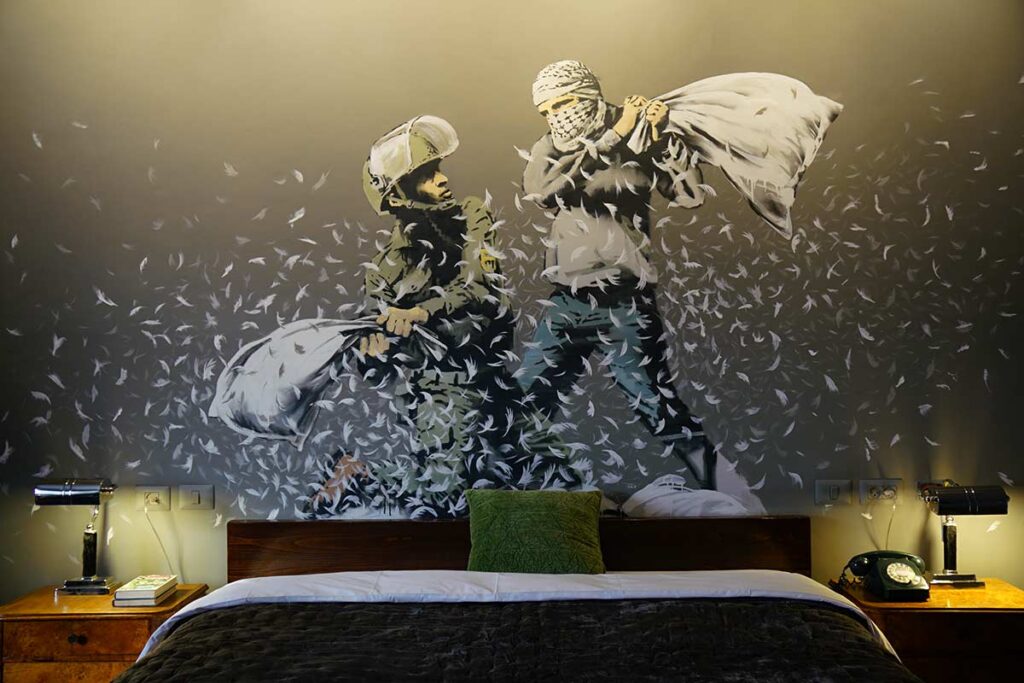
Scenic Rooms: The mid-range rooms are ensuite and equipped with wifi, fridge, radio, safe, and air conditioning. Floor-to-ceiling views of the graffiti-covered concrete wall frame almost every window. Several are within direct sightline of the army watchtower. Rooms in this category have been customised by Banksy, Palestinian activist and artist Sami Musa, and Canadian visual artist Dominique Petrin. One features a mural of an Israeli soldier in a pillow fight with a masked Palestinian protester. Another is painted entirely to look as though the walls themselves are concrete, so that the guest lies in bed inside what looks like the wall. Each room is a different experience and a different conversation.
Presidential Suite: Priced from $495 to $600 per night and described on the hotel’s own website as “equipped with everything a corrupt head of state would need.” The suite contains a plunge bath large enough for four people (the water feature is crafted from a bullet-riddled tank), a home cinema, a library, a roof garden, a tiki bar, original Banksy artwork including murals of cheetahs across the walls, a red velvet bed, and a full set of Dead Sea bath minerals. In-room dining is available on request. It is, by some distance, the most satirically conceived luxury suite on Earth.
Over 20 original Banksy works are displayed throughout the property. One of the paintings created for the hotel, Mediterranean Sea View 2017, was later sold at Sotheby’s for £2.23 million. All proceeds went to the Bethlehem Arab Society for Rehabilitation.
The piano bar
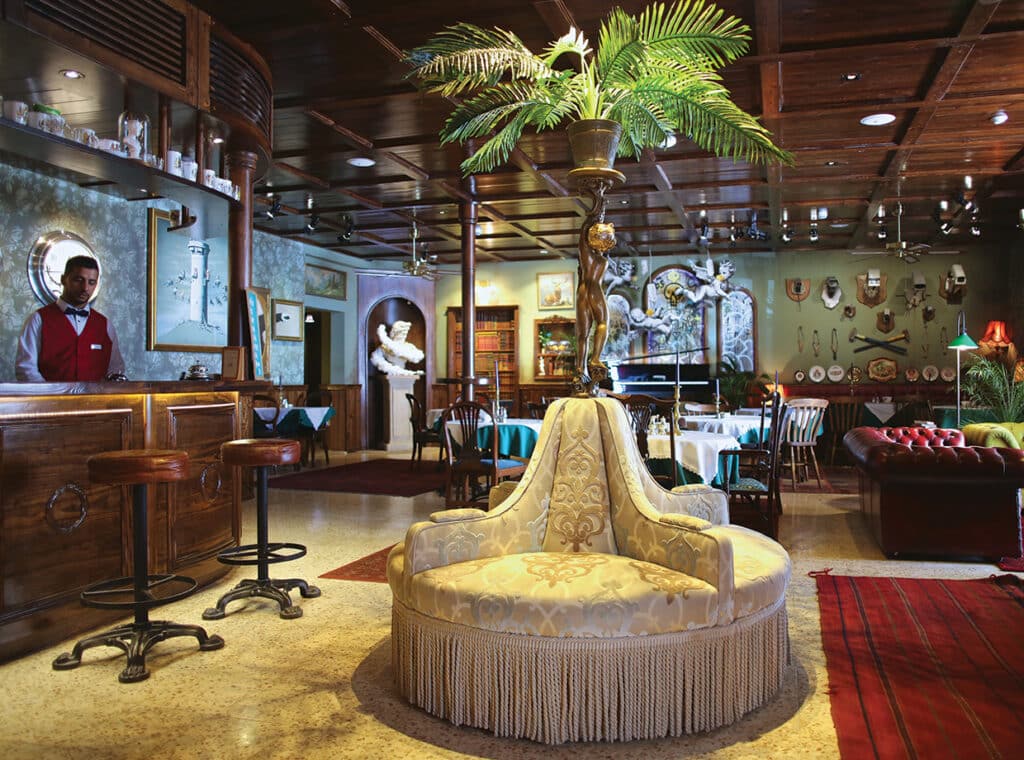
The colonial-themed piano bar is one of the most carefully constructed rooms in the building. It is a direct reference to Britain’s 1917 acquisition of Palestine, styled as a Victorian colonial outpost, complete with ceiling fans, dark wood, and the particular atmosphere of a place that once decided the fate of other places without asking them.
The bar is equipped with a large collection of Banksy artworks. Sculptures around the room depict figures choking on tear gas fumes. Security cameras are mounted on the walls like trophy deer heads. Sledgehammers and slingshots hang alongside them as decorative objects.
The centrepiece is a remote-controlled mechanical baby grand piano, programmed with a bespoke score of original compositions by Massive Attack’s 3D, Trent Reznor and Atticus Ross, Flea, and Hans Zimmer. It plays without a pianist. Above it hang cherubs on life support.
The bar serves afternoon tea, scones, and the Walled Off Salad. It is open to non-residents.
The museum
The hotel’s museum was curated in collaboration with Dr. Gavin Grindon from Essex University and is one of the most thoughtfully assembled small museums in the Middle East.
It tells the story of the West Bank barrier: its construction, its political context, the United Nations ruling in 2004 that it was built illegally, its impact on the daily lives of Palestinians and Israelis, and its extraordinary transformation into one of the largest canvases of political art in the world.
At the museum entrance sits a wax figure of Lord Arthur Balfour, the British Foreign Secretary who signed the 1917 declaration. The exhibition includes an animated history of the region, original beach sculpture from Gaza, a bullet-damaged camera from the Oscar-nominated documentary Five Broken Cameras (the damaged camera itself is on display), audiovisual installations, and what the hotel describes, in characteristic deadpan, as “military pornography.”
The museum makes a careful effort not to take a side in the Israeli-Palestinian conflict. It attempts, instead, to tell every side of the story and give visitors the context to understand it for themselves. Guests and visitors consistently describe emerging from it changed.
“I came out crying. My heart has been hurting for Palestine since. We learnt so much. I encourage you to take the time to read everything in there and watch the videos until the end.”
The museum is open to non-residents daily from 11am, as are the gallery and piano bar.
The gallery
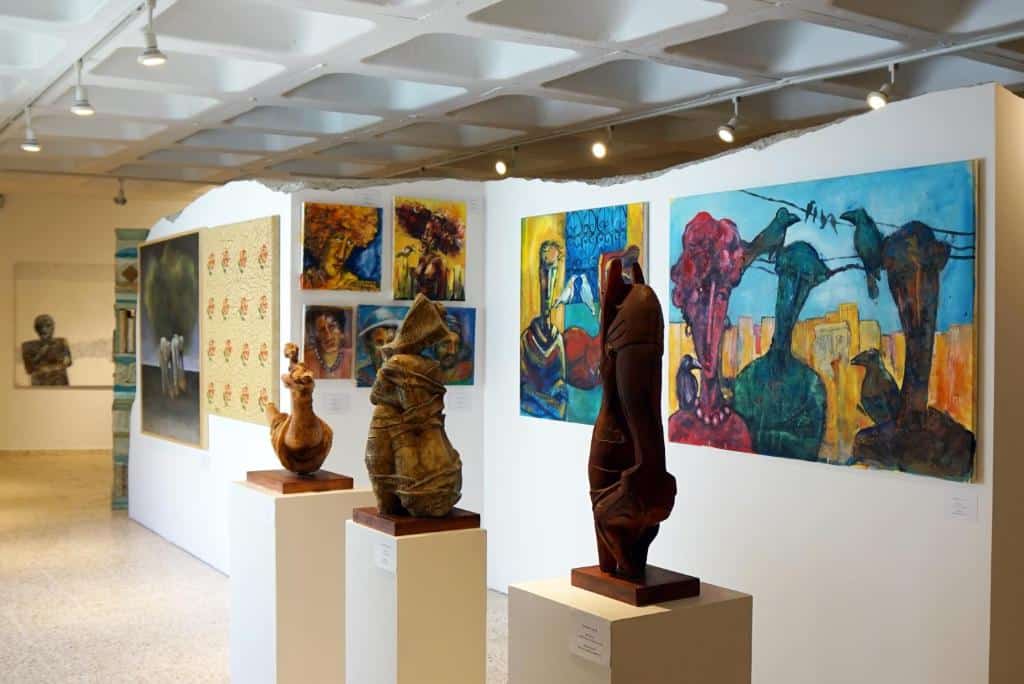
The art gallery inside the Walled Off is described as the largest permanent platform for Palestinian artists to showcase their work within Palestine. It operates independently from the hotel itself.
The permanent collection was curated by historian and critic Dr. Housni Alkhateeb Shehada and focuses on Palestinian artists and the diaspora. Rotating exhibitions are organised by local curators and have included works by established Palestinian artists such as Suliman Mansour, Nabil Anani, and Munther Jawabreh. A separate space is dedicated to emerging artists.
The gallery is intended to use Banksy’s own fame as a mechanism to bring Palestinian art to an international audience that might not otherwise encounter it. It works. Visitors who came specifically for the Banksy artwork frequently describe the Palestinian artists’ work as the part of the visit that stayed with them longest.
The Wall*Mart and the wall outside
Next to the hotel is a shop called Wall*Mart (the asterisk is doing significant work). It sells spray paint, stencils, and graffiti supplies to guests who want to add their own message to the barrier outside.
The wall directly in front of the hotel is one of the most significant surfaces of political art in the world. Banksy painted nine murals on it as early as 2005, including Flying Balloon Girl (a girl being lifted toward the sky by balloons), Love is in the Air (a masked protester throwing flowers), and Stop and Search (a boy beneath a rope ladder stretching toward the top of the wall). In 2007 he returned to add a young girl frisking an Israeli soldier, and an armoured dove wearing a bulletproof vest.
The wall is regularly painted over, creating a constantly rotating surface for new work. Guests are encouraged to add their own.
The hotel’s manifesto on the wall is clear: “Banksy has said it essentially turns Palestine into the world’s largest open prison.” The hotel’s website adds, more carefully: “Depending on who you talk to, it’s either a vital security measure or an instrument of apartheid. The one thing beyond dispute is that everything here is under dispute.”
ADVERTISEMENT
Visiting in 2026: what to know before you go
The hotel has reopened. After closing on October 7, 2023, following the outbreak of war in Gaza, the Walled Off reopened in December 2025. It is currently operating as a hotel, gallery, museum, and bar. The manager, Wisam Salsaa, described the reopening as “cautious hope” and the hotel as “a vehicle for the amplification of voices of peace.”
Getting there requires crossing through Israel. There are no international airports in Palestine. All access is overland through Israel, and the Palestinian border is controlled by Israeli authorities. The checkpoint crossing can be a challenging experience. The hotel advises guests to expect thorough questioning at Tel Aviv’s Ben Gurion Airport, which it describes with characteristic understatement as “legendary.” The hotel recommends paying for a hotel-arranged transfer rather than attempting to navigate the crossing independently, particularly for first-time visitors or solo travellers.
What to say at the border. The hotel advises guests that the most straightforward approach at the Israeli border is to state that you are visiting Bethlehem for religious sites and cultural visits. This is accurate. The hotel itself is a cultural visit.
Rooms from $70 to $600. The Budget Barracks bunk starts at $70 per night. Scenic ensuite rooms run mid-range. The Presidential Suite runs from $495 to $600. All rooms include the extraordinary common spaces: the piano bar, museum, gallery, bookshop, and breakfast.
Breakfast. Guests consistently highlight breakfast as a genuine highlight of the stay: shakshuka, hummus, falafel, fresh pita, chocolate croissants, sesame sweets, fresh juice, coffee, and tea. It is served in the hotel’s communal dining area surrounded by Banksy artworks.
For non-residents. The museum, gallery, and piano bar are open to the public daily from 11am. A visit without staying overnight is entirely possible and worthwhile. Many guests who planned a day trip end up booking a room.
Prepare before you arrive. Every review from experienced visitors makes the same recommendation: watch documentaries about the Israeli-Palestinian conflict before arriving so that the visit lands with the full weight of its context. The hotel provides information and framing, but arriving with some prior understanding transforms the experience significantly.
Travel advisory. The British Foreign Office advises against all but essential travel to Gaza and the West Bank, with a specific exemption for Bethlehem, which is listed alongside East Jerusalem, Ramallah, and Jericho as safe for travel. The US State Department similarly lists Bethlehem separately from its broader West Bank advisory. Bethlehem itself is considered safe for tourists and receives significant numbers of Christian pilgrims and cultural visitors year-round. Always check your own government’s current travel advisory before booking, as the situation in the region can change.
What the hotel actually is
The Walled Off is not a comfortable hotel that happens to have interesting art. It is an argument, made in three dimensions, about what it means to look at something and choose not to look away.
The “worst view in the world” is a provocation in the Banksy tradition: technically true, and exactly wrong. The view is the most consequential thing about the hotel. The concrete, the watchtowers, the murals, the checkpoint in the distance: these are not the backdrop to the experience. They are the experience. The rooms, the museum, the piano bar, the gallery, and the breakfast all exist in service of getting visitors close enough to a reality that the rest of the world mostly views from a comfortable distance.
“We believe a hotel can be more than just a place to rest your head,” the hotel’s manifesto reads. “It can be a place of reflection, conversation, and connection. A three-storey fight against fanaticism, with breakfast included.”
It is, by a significant margin, the most important hotel on this list. Possibly the most important hotel in the world.
The essentials
- Address: 182 Caritas Street, Bethlehem.
- Status: Open as of December 2025, operating in 2026
- Rooms: From $70/night (Budget Barracks) to $495 to $600 (Presidential Suite)
- Public access: Museum, gallery, and piano bar open daily from 11am (non-residents welcome)
- Getting there: Overland via Israel; hotel-arranged transfer strongly recommended
- Book via: walledoffhotel.com or contact reception@walledoffhotel.com
- All profits: Returned to local Palestinian community projects
Some links in this post are affiliate links. If you book through them, flight.now earns a small commission at no extra cost to you. Learn more here