
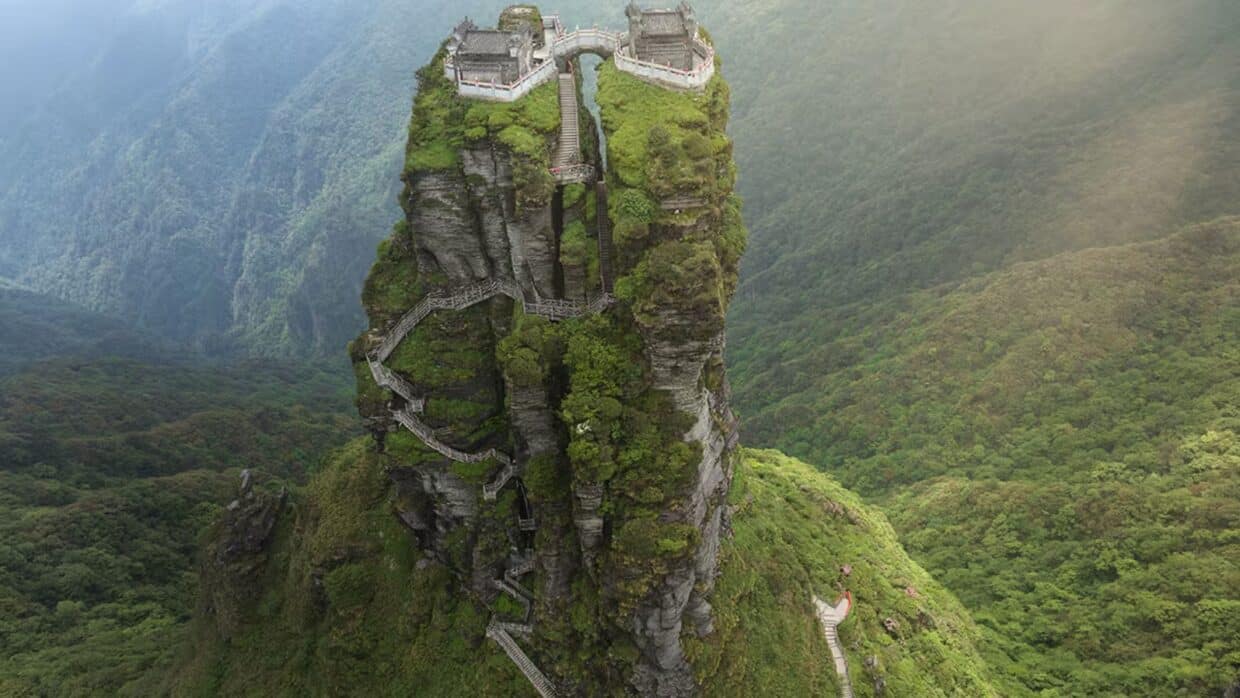
There is a photograph that stops people mid-scroll every time it appears. Two small Buddhist temples perched on twin rock pinnacles rising from a sea of clouds, connected by a narrow stone bridge, with nothing beneath them but the mist and the mountain. It looks generated. It looks like concept art for a film that hasn’t been made yet. It is, in fact, a real place in the Guizhou province of southwest China, and you can stand on that bridge.
The place is Fanjingshan, or Mount Fanjing. The name translates as “Buddhist tranquility.” The temples at the top are dedicated to Maitreya Buddha and Shakyamuni Buddha, representing the future and the present, and the mountain beneath them is considered one of the five most sacred Buddhist sites in China. It was granted UNESCO World Heritage status in 2018. Before that, it was mostly known to Chinese pilgrims and the small number of travellers who had stumbled across the photograph and gone to verify it.
That number is growing. The crowds are real and require management. But Fanjingshan remains, in every way that matters, one of the most extraordinary places on Earth.
What you are actually looking at
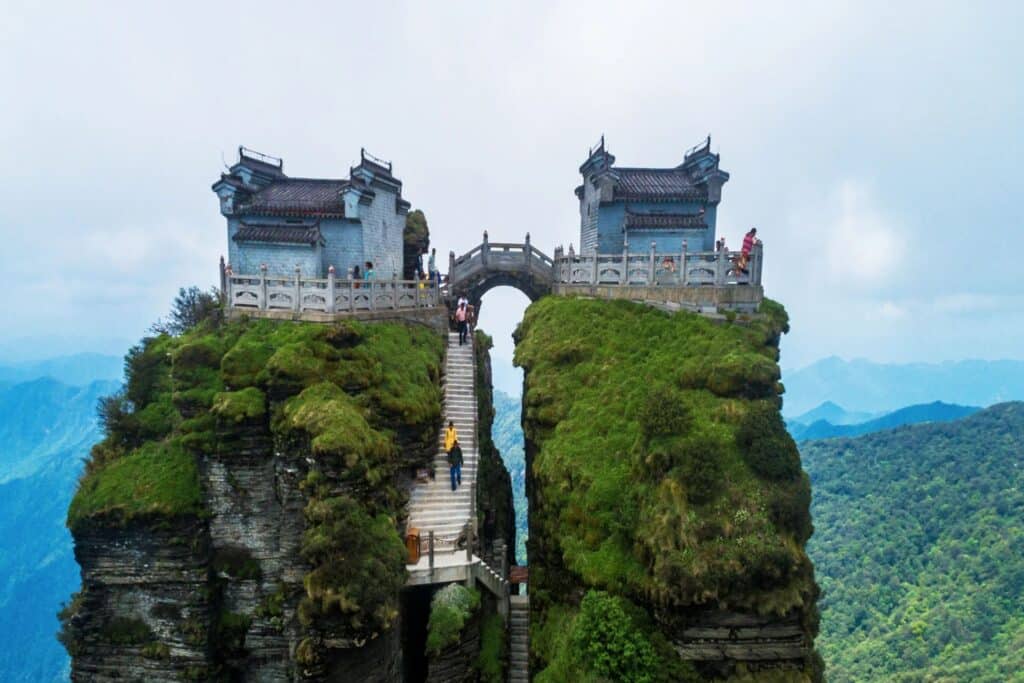
The rock formation that holds the temples is called the Red Clouds Golden Summit, also known as the New Golden Summit. It rises approximately 100 metres from the already high mountain plateau, which itself sits at 2,336 metres above sea level. The two pinnacles are natural: formed over 65 million years of karst geology, split by a natural gorge called the Gold Sword Gorge. The stone bridge connecting them is a modern reconstruction built for safety, but the gorge and the pinnacles are entirely geological.
The Temple of Shakyamuni sits on the left pinnacle. The Temple of Maitreya sits on the right. Both were originally constructed during the Ming Dynasty, some sources say during the Tang Dynasty as early as 639 AD, with reconstructions and additions continuing through the Song, Yuan, and Ming periods. They have been destroyed and rebuilt multiple times across the centuries, the last major restoration completed in the 20th century.
The final approach to the temples involves a near-vertical stone stairwell at an incline of approximately 70 to 80 degrees, with metal chains bolted into the rock on both sides that visitors grip for the ascent. It is not technically dangerous in dry conditions, but it is genuinely steep in a way that the word “steep” fails to prepare most visitors for. The ascent from the plateau takes around 20 minutes. In wet conditions the summit trail is closed.
The view from the bridge between the two temples is the one from the photograph. In person, with the clouds moving below you and the mountain dropping away on all sides, it is something else entirely.
The other things worth seeing
The Red Clouds Golden Summit gets all the photographs, but Fanjingshan is a full day’s worth of destinations in itself.
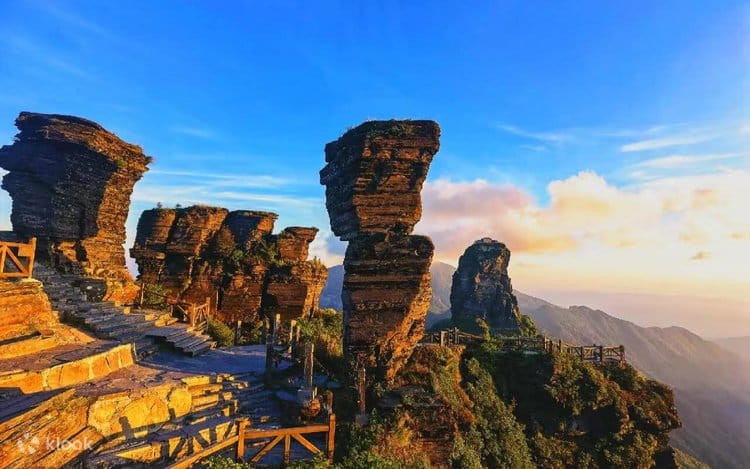
Mushroom Stone is the first major landmark after the cable car and the image that defines the mountain’s geological identity: a ten-metre-high rock formation shaped exactly as named, a broad cap balanced on a narrowing column, sitting in the middle of the mountain landscape as if placed there deliberately. It is 65 million years old. Visitors reach it after a short walk from the cable car station and it makes the case immediately that this mountain’s geology is unlike anything in Europe or North America.
Old Golden Summit is the second major peak at 2,493 metres, slightly higher than the Red Clouds Golden Summit and offering a panoramic view of the entire mountain landscape including the twin temple peaks below. It requires less vertical effort than the Red Clouds climb and is described consistently as the best vantage point for photographing the temples themselves. On days when the Red Clouds Summit queue is very long, going to the Old Golden Summit first while waiting for your numbered slot is the standard strategy.
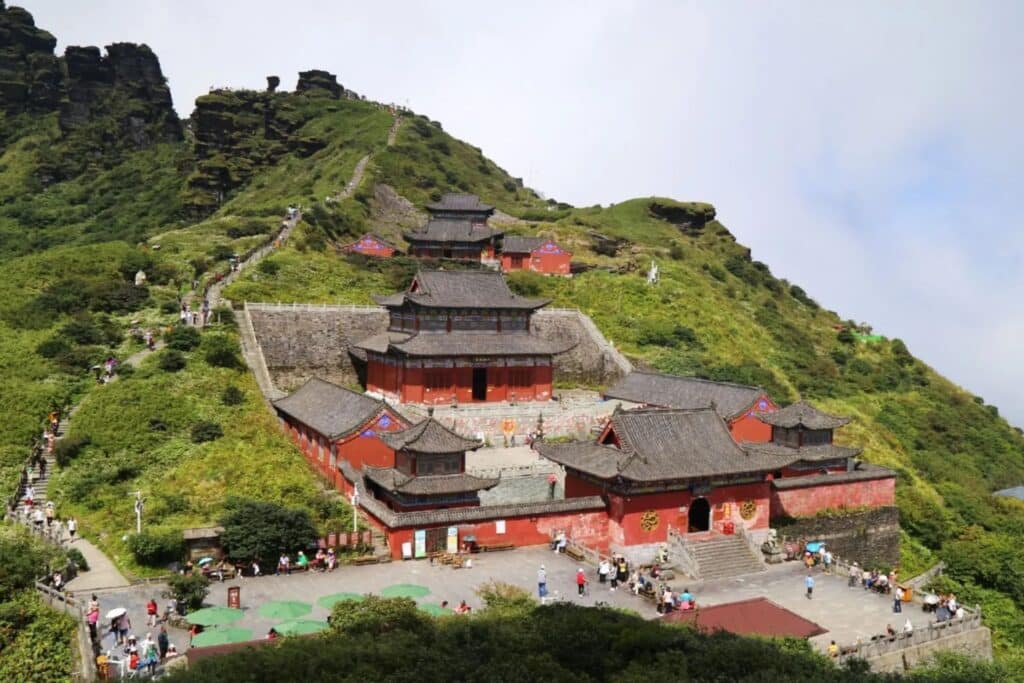
Chengen Temple sits between the two summits at a slightly lower elevation and is one of the finest examples of early Ming Dynasty temple architecture still standing in southern China. Approximately ten halls with red walls and dark tiles enshrine various Buddha figures within a complex that feels genuinely ancient rather than reconstructed. The temple occasionally serves free porridge around 11:30am to visitors, which is the kind of detail that a place with 1,300 years of history can afford to offer casually.
The Mushroom Stone forest and karst landscape along the hiking trail between attractions rewards slow walkers. The mountain supports over 3,700 plant species, and the density and variety of the forest between landmarks is part of what earned the UNESCO designation. The endangered Guizhou snub-nosed monkey lives here and is found nowhere else on Earth. Sightings are uncommon but possible on quieter sections of the West Gate trail.
How to get there
Fanjingshan is located in Tongren City, Guizhou Province, in southwest China. Getting there has become significantly easier since China’s high-speed rail expansion reached the region, but it still requires planning.
By high-speed train: The most practical option for international visitors. High-speed trains connect Tongren South Station (Tongrennan) from Guiyang in approximately 1.5 hours, from Changsha in 2.5 hours, and from Chengdu or Chongqing in 3 to 4 hours. Guiyang itself is directly connected to major Chinese cities including Beijing, Shanghai, Guangzhou, and Chengdu.
By air: Tongren Fenghuang Airport has direct flights from Beijing, Shanghai, Guangzhou, Shenzhen, Guilin, Kunming, and several other Chinese cities. Flight times range from 1 to 2.5 hours depending on the origin.
From Tongren to the mountain: From Tongren South Railway Station or Fenghuang Airport, the drive to the Fanjingshan Visitor Center takes approximately 1.5 hours. Tourist shuttle buses run from Tongren to the park. Didi (China’s equivalent of Uber) is reliable from Tongren and the most straightforward option for independent travellers.
Combining with other destinations: Fanjingshan pairs naturally with nearby destinations. Zhangjiajie (the mountain landscape that inspired the floating mountains in Avatar) is a 3 to 4-hour train journey away. Fenghuang Ancient Town, one of the best-preserved ancient Chinese river towns, is accessible from Tongren. The minority villages of Kaili in eastern Guizhou, home to Miao and Dong ethnic communities with extraordinary traditional festivals, are around 2 hours away.
Booking tickets (read this before you do anything else)
This is the section that trips up the most visitors, and getting it wrong means not reaching the summit.
Tickets are 100% digital and strictly advance-purchase. There are no walk-in tickets available at the gate. Tickets must be booked online, or through the official Fanjingshan Tourism Zone WeChat mini-program, which releases tickets daily at 8:00am Beijing Time for visits seven days in advance. During peak season they sell out within minutes of release.
For non-Chinese visitors who cannot easily navigate the WeChat booking system, the most reliable options are:
- Ask your hotel concierge in Tongren or Jiangkou to book the moment the 8:00am window opens
- Use Trip.com, which handles Fanjingshan tickets for international visitors at a small service fee
- Book through a licensed tour operator who bundles transport and tickets together
The Red Clouds Golden Summit requires a separate queue registration on the day. Once inside the park, visitors scan a QR code at Mushroom Rock or Chengen Temple to register for a numbered time slot to ascend the final summit. These slots fill up extremely quickly. The critical insider instruction that every experienced visitor shares: as soon as you step off the cable car, find and scan the QR code for the summit reservation before doing anything else. If your assigned number puts you hours away, use the waiting time to visit the Old Golden Summit and Chengen Temple.
Ticket costs (approximate 2026 figures, confirm when booking):
- Entrance ticket: ~148 RMB (approximately $20)
- Cable car (round trip): ~140 RMB (approximately $19)
- Shuttle bus within the park: additional fee
The total entry cost for most visitors runs approximately 200 to 300 RMB including all transport.
When to go
September to November is the sweet spot. Autumn brings clear skies, cooler temperatures at altitude, and the mountain forests turning red and gold. The sea of clouds effect that produces the iconic photographs is most reliable in the morning after overnight mist.
March to May is the second-best window, with azalea blooms covering the mountain slopes and generally clear weather before the summer heat builds.
June to August brings the rainy season. The mist and drama can be extraordinary for photography, but the Red Clouds Golden Summit trail closes regularly when wet conditions make the near-vertical stairwell unsafe. Summer also brings peak domestic tourism crowds.
December to February brings snow, which transforms the mountain into a different kind of spectacular. The summit is accessible on clear days but the cold at 2,500 metres is significant and some facilities operate on reduced schedules.
Always aim to take the first cable car of the morning, which typically starts running around 7:30 to 8:00am. The clouds are at their most dramatic in early morning, the light is better for photography, and you reach the summit registration queue before the main crowds.
Practical notes
The cable car is strongly recommended for the ascent. The alternative is 8,000 to 9,000 steps from the base, which takes approximately 4 to 5 hours and is a serious physical undertaking. The cable car reduces the hiking portion to a manageable 1.5 to 2-hour walk on the plateau. Experienced hikers sometimes take the West Gate route on the way up (no cable car, 8,000 steps, 3 to 4 hours, fewer crowds) and the cable car down, which gives both the immersive hiking experience and the efficiency.
Weather changes extremely fast at 2,500 metres. Bring a jacket regardless of the temperature at the base. Rain gear is recommended year-round. The summit is frequently several degrees cooler than the valley.
Footwear matters. The final ascent involves near-vertical stone steps that become slippery when wet. Proper hiking shoes or boots are recommended. Visitors in fashion trainers or flat soles consistently describe difficulty on the final section.
A VPN is essential for China travel generally. Google Maps, Instagram, WhatsApp, and most Western apps do not function in China without one. Download and activate it before arriving.
Payment at Fanjingshan and in surrounding towns is overwhelmingly WeChat Pay or Alipay. International cards are not reliably accepted. Having some Chinese yuan cash as a backup is recommended; the Visitor Center has a luggage storage facility for 30 RMB if you’re travelling light on the day.
Photography. Drones are not permitted within the scenic area. The best photographs of the twin temples are taken from the Old Golden Summit looking across at the Red Clouds Golden Summit, particularly in morning mist. The bridge between the two temples looking outward in any direction also produces the images that define the mountain.
Visa and entry
China’s 30-day visa-free policy for many nationalities has been extended through December 2026. Citizens of over 50 countries including the UK, US (note: check current US-China relations for latest status), Canada, most EU nations, Australia, and New Zealand are eligible. Guizhou Province is covered under this policy.
The 144-hour visa-free transit applies specifically to layover travellers passing through certain designated entry ports. Guiyang is not always included as a standalone 144-hour transit port; confirm the current list on the National Immigration Administration website before planning around transit entry.
Always check your own government’s current travel advisory and the latest Chinese entry requirements before booking, as policies can change.
How long to spend
One full day covers all the main highlights comfortably if you take the cable car and start with the first morning departure. The recommended schedule:
- First cable car, then immediately scan the Red Clouds Summit QR code for your time slot
- Mushroom Stone (30 minutes)
- Old Golden Summit (45 minutes to 1 hour)
- Chengen Temple (30 to 45 minutes, try the porridge if it’s being served)
- Red Clouds Golden Summit when your number is called (allow 1.5 hours including the ascent, bridge, and descent)
- Return by cable car
Two days is the relaxed version: arrive and stay overnight in Jiangkou (the small town closest to the park entrance), visit the mountain the following day without time pressure, and potentially combine with a morning at one of the ethnic minority villages nearby.
The thing about the photograph
Every visitor arrives having seen the photograph. The two temples on the twin pinnacles above the clouds, impossibly suspended. The question most people have before arriving is whether it actually looks like that in person, or whether it’s the work of a very good drone and a very long lens.
It actually looks like that. On a clear morning with the sea of clouds moving below, standing on the bridge between the two temples with the mountain dropping away beneath you and the mist filling the valleys in every direction, it looks exactly like the photograph. Possibly better.
The photograph prepared you for what you’d see. Nothing prepares you for what it feels like to be standing there.
The essentials
- Location: Tongren City, Guizhou Province, southwest China
- UNESCO status: World Natural Heritage Site since 2018
- Altitude: Red Clouds Golden Summit at 2,336 metres (summit pinnacle at 2,570 metres)
- Tickets: Digital only, book 7 days ahead via WeChat mini-program or Trip.com
- Entry costs: Approximately 200 to 300 RMB all-in including cable car and shuttle
- Best season: September to November; March to May
- First cable car: Approximately 7:30 to 8:00am (confirm locally)
- Getting there: High-speed train to Tongren South, then shuttle or Didi to park
- Nearest city: Tongren (1.5 hours)
- Pairs well with: Zhangjiajie, Fenghuang Ancient Town, Kaili ethnic minority villages
Some links in this post are affiliate links. If you book through them, flight.now earns a small commission at no extra cost to you. Learn more here