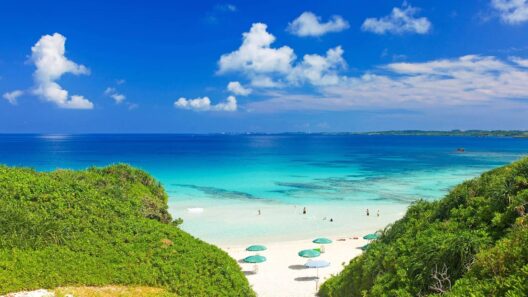
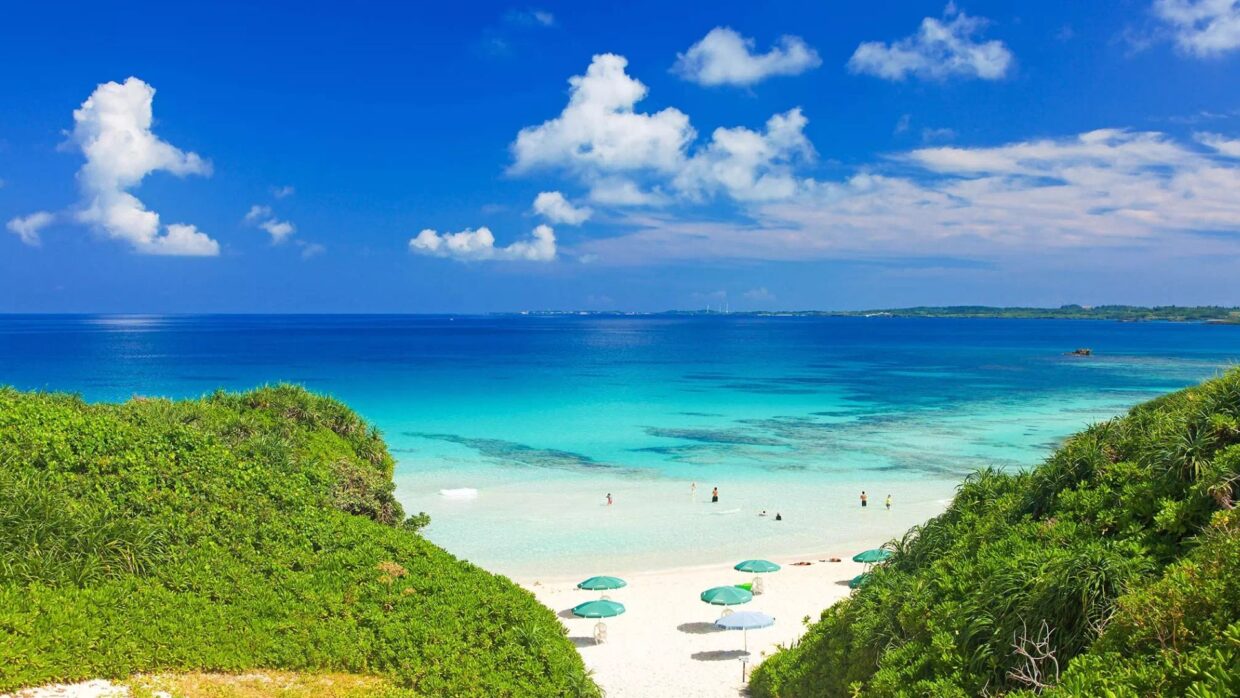
There is a term used by divers and marine researchers for the water around the Kerama Islands, 40 kilometres west of Naha. They call it Kerama Blue. It is not a marketing phrase. It is a specific, documented quality of water clarity produced by a combination of clean currents, shallow coral reef platforms, and the absence of river sediment from the surrounding islands, a transparency so total that visibility can reach 40 metres or more on a good day, and the colour from above, somewhere between turquoise and a blue that has no satisfactory name, is different from anything available in mainland Japan.
The Kerama Islands hold over 60 percent of Japan’s reef-building coral. The beaches of Miyako Island are consistently ranked among the finest in Asia. The manta ray cleaning stations off Ishigaki in the Yaeyama group are among the most reliable manta encounters in the world.
The underwater ruins off Yonaguni Island are among the most mysterious dive sites on earth. And the Blue Cave on Okinawa’s main island, where sunlight refracts through a submarine entrance to light the water in electric blue, can be reached on a morning tour from Naha.
This is the guide to the water, the beaches, the reefs, the dive sites, the snorkelling, and the marine encounters that make the Okinawa archipelago one of the finest marine destinations in Asia.
Understanding the water: a guide to clarity
Before the specific locations, the most useful piece of information for planning a water-focused visit to Okinawa: different island groups offer fundamentally different water experiences, and choosing the right one for what you want to do matters considerably.
Miyako Island wins on raw clarity and beach perfection. Miyako is flat coral limestone with no rivers, which means nothing muddies the sea. The water here, the Miyako Blue, as distinct from the Kerama Blue, is flat, pale, and so clear it barely looks real in photographs. Yonaha Maehama Beach on the southwest coast, seven kilometres of powder-white sand with water of this quality in front of it, is the finest beach in Japan by most serious assessments.
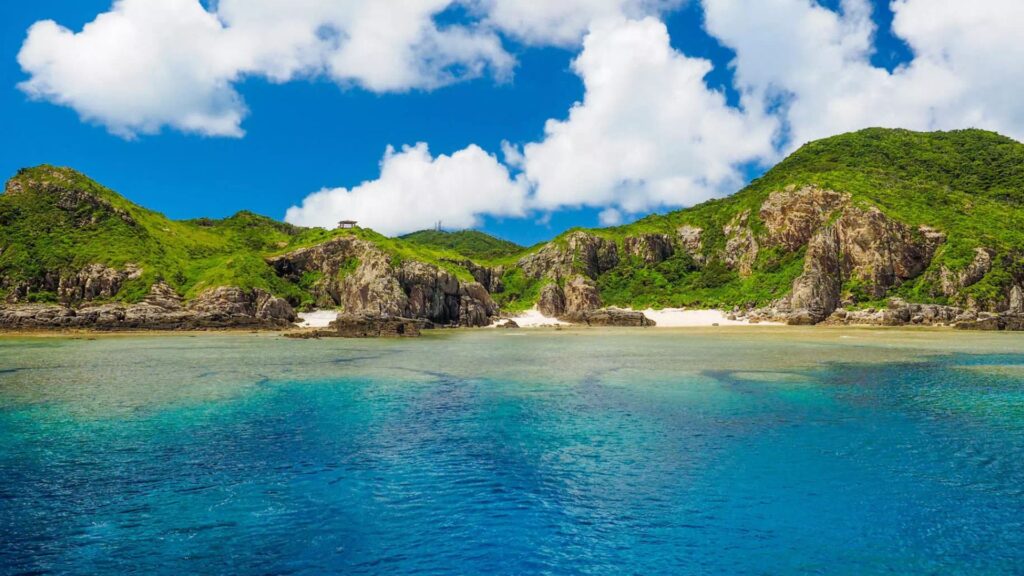
The Kerama Islands win on snorkelling and coral reef quality. The proximity of the reefs to the shore at Furuzamami and Aharen means you can snorkel directly off the beach into extraordinary coral coverage. The Keramashoto National Park protects an ecosystem of exceptional richness that is accessible without a boat on many of the best islands.
Ishigaki and the Yaeyama Islands win on diving variety and specific marine encounters. Manta Scramble off Ishigaki is one of the most reliable manta ray dive sites in the world. The underwater geography, walls, caves, arches, the mysterious Yonaguni formations, is the most technically diverse in the archipelago.
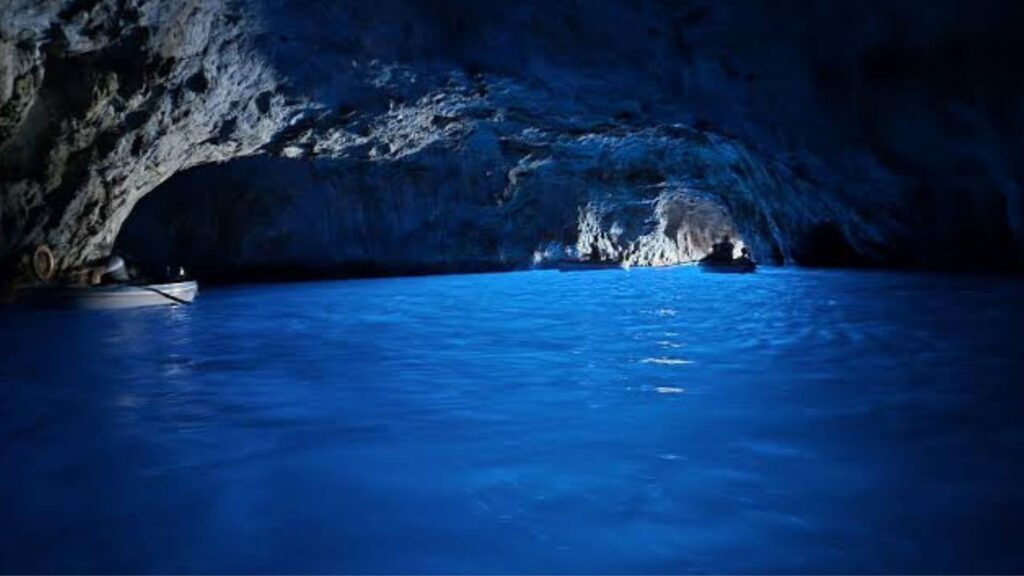
The main island wins on convenience. The Blue Cave, Cape Maeda, and several accessible reef sites are reachable on a half-day trip from Naha without requiring a ferry or flight. They are not the finest sites in the archipelago but they are genuinely good and they require the least logistical effort.
The Kerama Islands
The 22 islands of the Kerama group sit southwest of Naha, reachable by high-speed ferry in 30 to 35 minutes. Only four are inhabited, Zamami, Tokashiki, Aka, and Geruma, and together they constitute the finest snorkelling environment in Japan and one of the finest in Asia.
Zamami Island
The most visited of the Kerama Islands and the one with the most complete visitor infrastructure, accommodation, restaurants, dive shops, and rental equipment all available. Two beaches bookend the Zamami experience: Furuzamami Beach and Ama Beach.
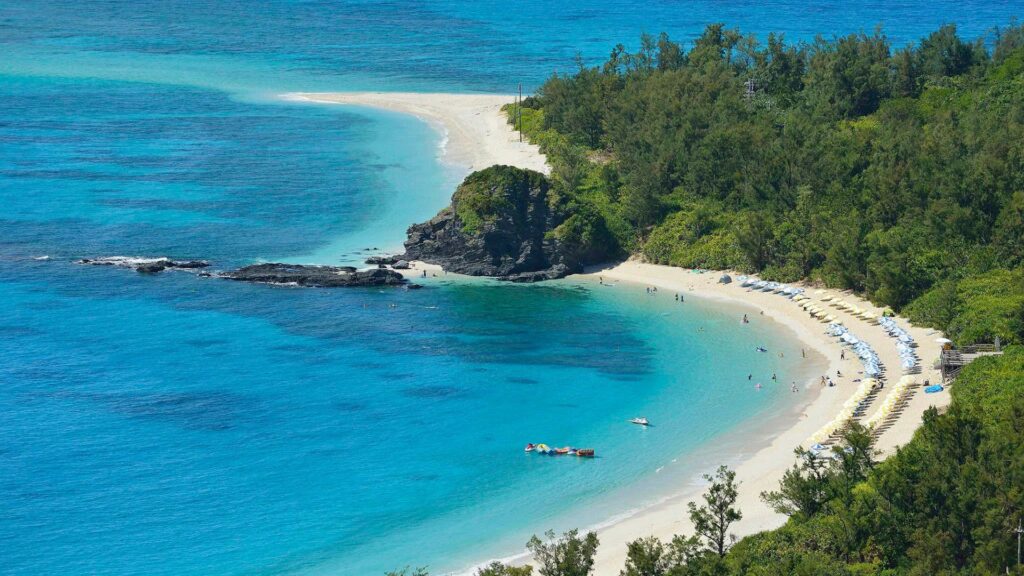
Furuzamami Beach is the island’s finest, a long crescent of white sand with the reef beginning almost at the shoreline, meaning you can simply wade in and start snorkelling. The coral coverage close to shore is exceptional by any international standard. Sea turtles are regular sightings, one operator running snorkel tours from Zamami advertises 97 percent turtle encounter rates, which is not a marketing claim but a reflection of how reliably the turtles appear at specific reef sections.
The ferry from Naha’s Tomari Port takes approximately 50 minutes on the high-speed service. Day trips are possible but an overnight stay transforms the experience, the island after the day-trippers have departed has a quietness and authenticity that is impossible to access in a single day.
Whale watching from Zamami (January to March): Humpback whales migrate through the Kerama channel between January and March, and Zamami is one of the finest bases in all of Japan for humpback encounters. The whales are frequently visible from the ferry between Naha and the island during this period, and dedicated whale watching tours from the island provide close approaches to animals that are reliably present. The combination of humpback whale watching in the morning and coral reef snorkelling in the afternoon, from the same island base, is one of the more extraordinary single-day wildlife experiences available in Asia.
Tokashiki Island
Larger than Zamami and less visited, Tokashiki has a different character, less manicured, more spacious, with two excellent beaches and a slower pace that rewards an overnight stay over a day trip.
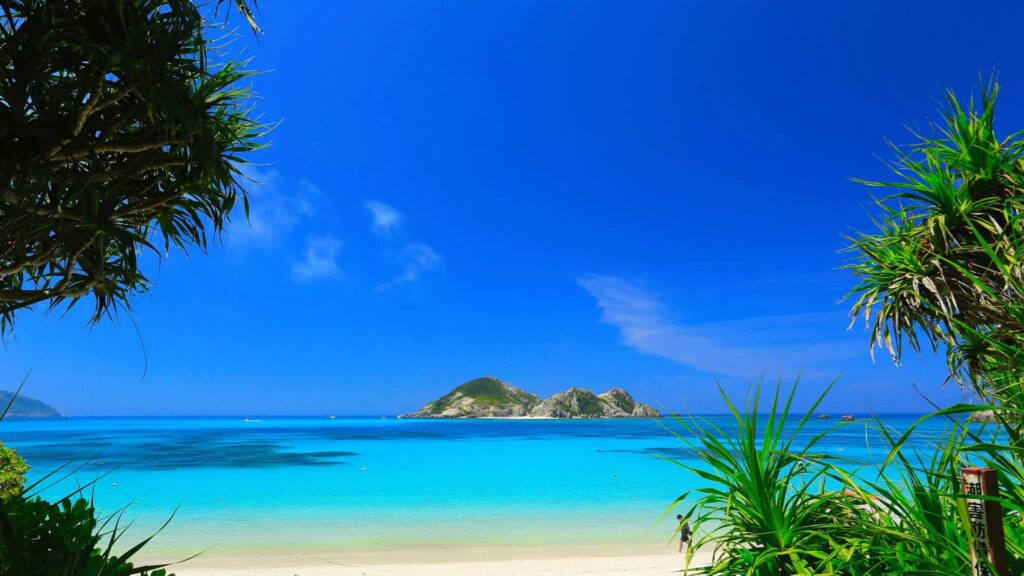
Aharen Beach on the island’s west coast is the primary destination, a wide, gently shelving beach with reef accessible from the shore and a small community of guest houses, restaurants, and dive operators behind it. The beach is less famous than Furuzamami and consequently quieter, with comparable water quality and reef access. The snorkelling between Aharen and the small islands offshore, accessible by kayak or snorkel tour, covers some of the finest reef terrain in the Keramas.
Tokashiki Beach on the east coast is the island’s other main beach, longer, more exposed to the Pacific swell, and better for swimming than snorkelling. The contrast between the calm, reef-sheltered west coast and the more dynamic east coast gives Tokashiki a range of water experiences unavailable on the smaller islands.
Miyako Island
290 kilometres southwest of Naha and reachable by a 45-minute flight or a longer ferry journey, Miyako delivers the finest beach experience in Japan and water so clear it redefines your expectations for what the word clear means when applied to ocean water.
Yonaha Maehama Beach
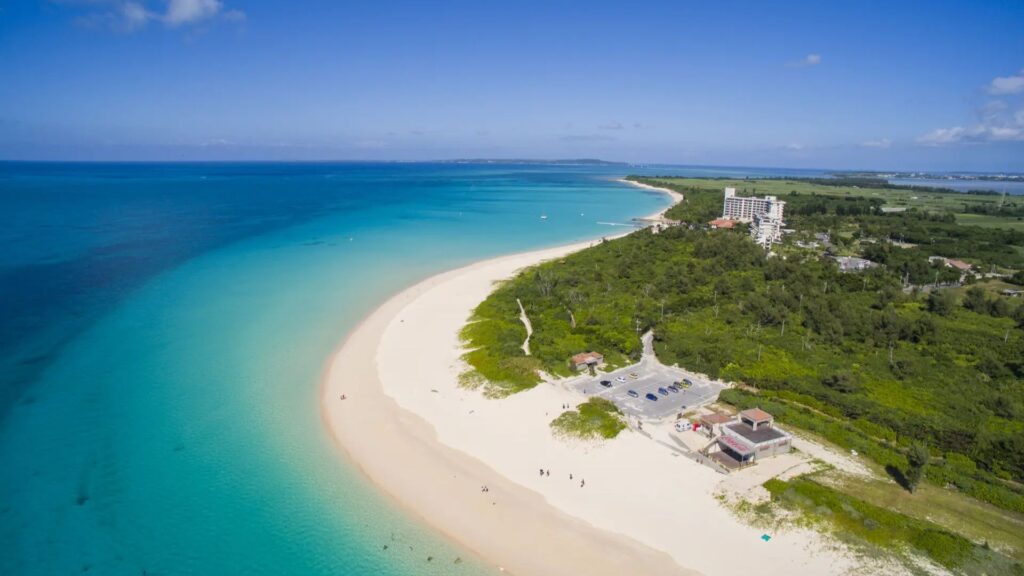
The most celebrated beach in Japan and the one most consistently placed in serious Asian beach rankings. Seven kilometres of powder-white sand on Miyako’s southwest coast, with the Miyako Blue in front of it, water so pale and so transparent that the sandy bottom is visible at depths that would obscure it anywhere else. The beach is flat, shelving gently, making it safe for swimming across a wide range of conditions. Kurima Bridge is visible at the far end of the beach, crossing to Kurima Island where the water quality and quietness exceed even Maehama itself.
What makes Yonaha Maehama extraordinary rather than merely beautiful is the consistency. The water here is reliably this colour, in this clarity, because Miyako Island’s flat coral limestone geology produces no rivers and therefore no sediment. This is structural clarity, not luck.
Sunayama Beach
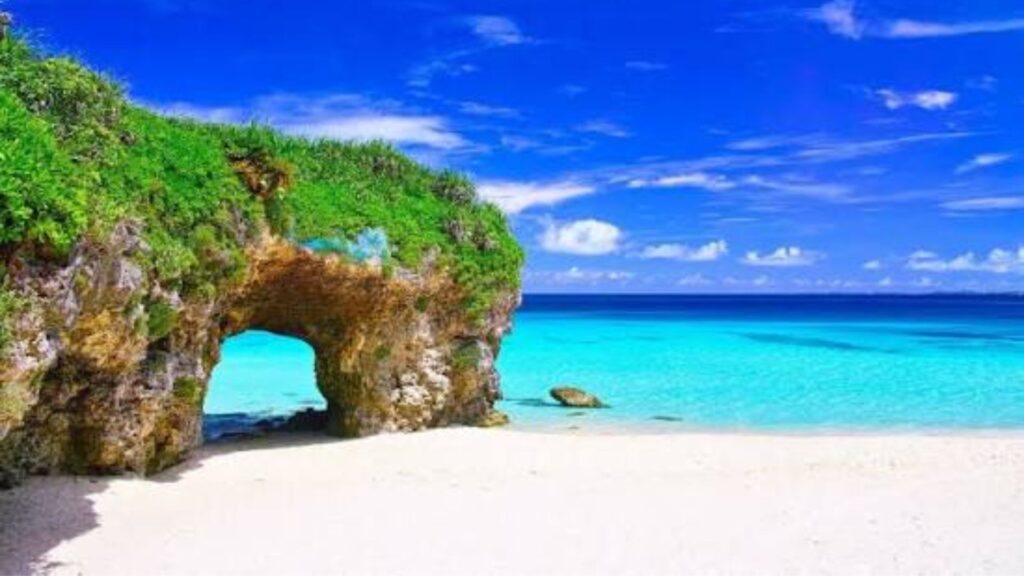
A shorter beach north of the main Miyako resort area, accessed by crossing a sand dune, the “sand mountain” the name translates to, and descending to a beach framed by a natural rock arch that frames the Miyako Blue beyond it. The arch has become one of the most photographed natural formations in Okinawa. The beach beneath it is genuinely fine: coarser sand than Maehama, clearer water than most visitors expect from a beach this close to the main resort area, and consistently less crowded than the beaches further south.
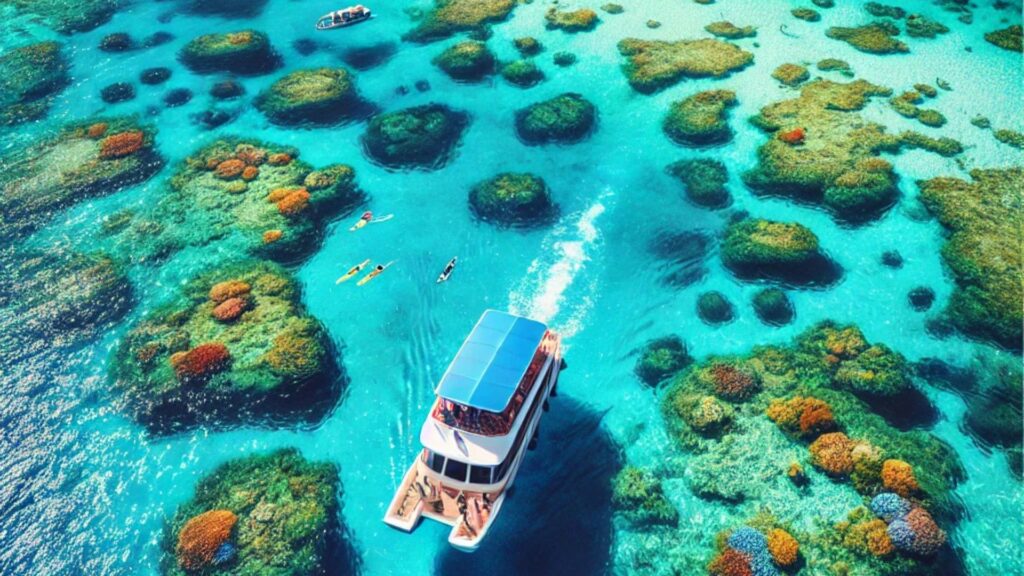
Yabiji Reef – snorkelling and diving
Off the northern coast of Miyako, accessible by boat tour, the Yabiji reef system is Japan’s largest coral reef group, a vast shallow reef platform that appears above the waterline at certain tidal conditions, creating a “phantom island” of sand surrounded by living coral. Tours departing from the Miyako coast offer snorkelling over the Yabiji reef and, at the right tidal moment, the extraordinary experience of walking on a sandbar that exists only for a few hours before the tide returns.
The diving around Irabu Island, connected to Miyako by a 3.5-kilometre bridge, is the finest in the Miyako group. Mao no Kyuden, “Devil’s Palace”, is a series of submarine limestone caves and arches along Irabu’s northwestern coastline that is considered among the finest cave diving in Japan for intermediate and experienced divers.
Ishigaki and the Yaeyama Islands
400 kilometres southwest of Naha, Ishigaki Island is the hub of the Yaeyama group, a cluster of islands that represent the most remote, most diverse, and in many ways most extraordinary part of the Okinawa archipelago. The marine environment here is the richest in the prefecture, and the specific dive sites available from Ishigaki are world-class by any international comparison.
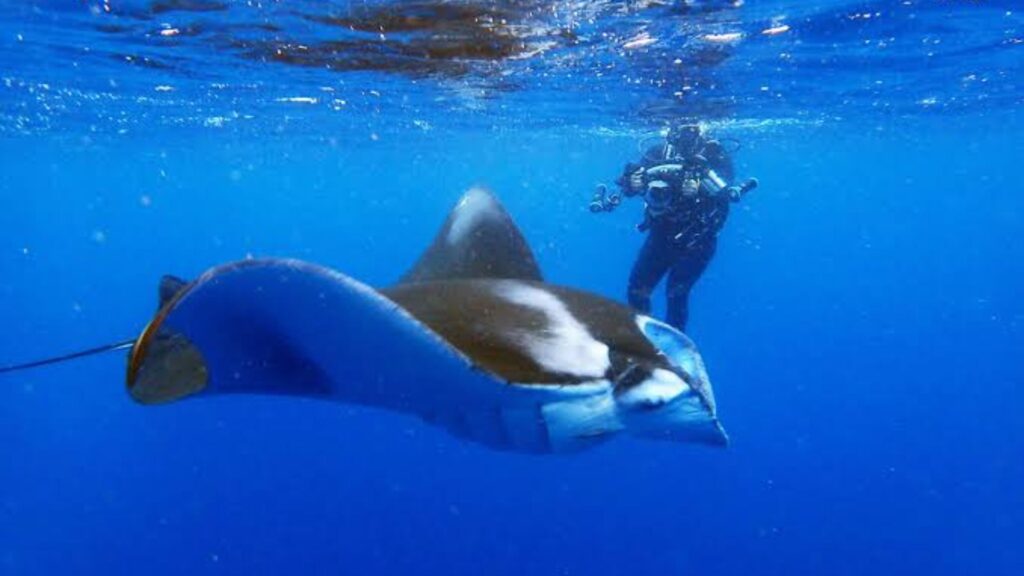
Manta Scramble, Ishigaki
The most famous dive site in Okinawa and one of the most reliable manta ray encounters in the world. A cleaning station off the northern coast of Ishigaki where manta rays congregate to have parasites removed by smaller fish, the underwater equivalent of a car wash, if the car was a three-metre wide manta ray. Sightings are essentially guaranteed between July and September when mantas appear in groups of five to twenty individuals. Outside peak season, mantas are present but less reliably in numbers. The dive itself is shallow and accessible to open water certified divers, the challenge is not the diving conditions but the emotional impact of the mantas themselves, which most divers describe as the most extraordinary encounter of their diving life.
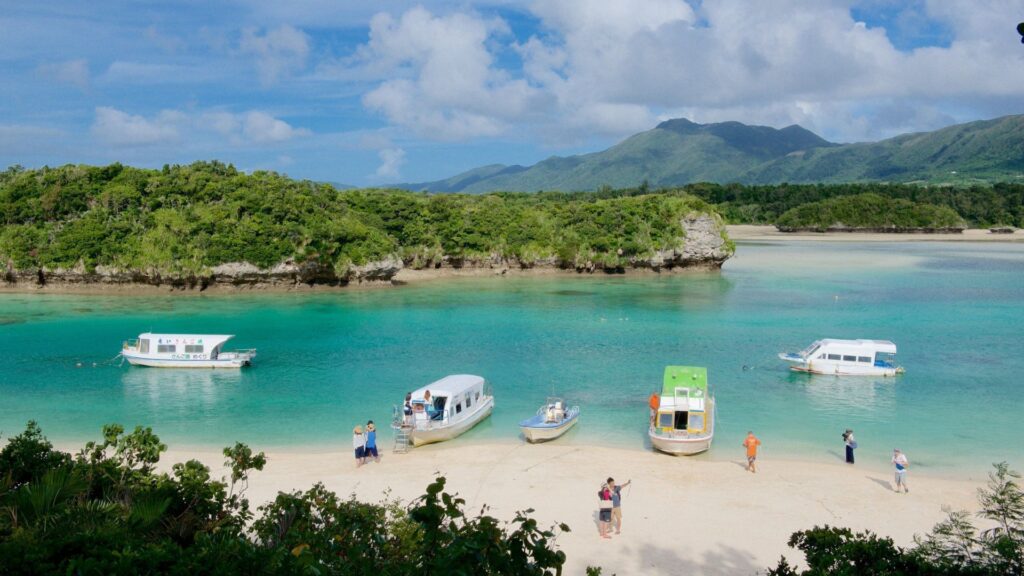
Kabira Bay
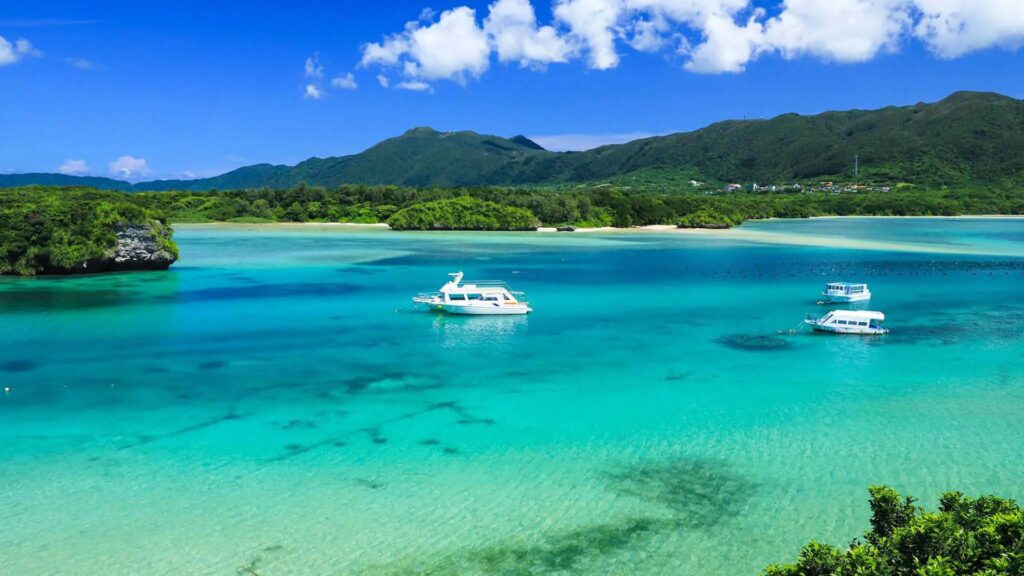
The most photographed bay in Okinawa, a shallow, sheltered inlet on Ishigaki’s north coast where the water is an extraordinary pale green-blue, dotted with small forested islands and sheltered by surrounding hills. Swimming in the bay is not permitted due to current research and black-pearl cultivation activity, but glass-bottom boat tours provide access to the underwater environment, and the visual impact from the shore alone is worth the visit. Entry to the bay viewpoint costs approximately 100 yen.
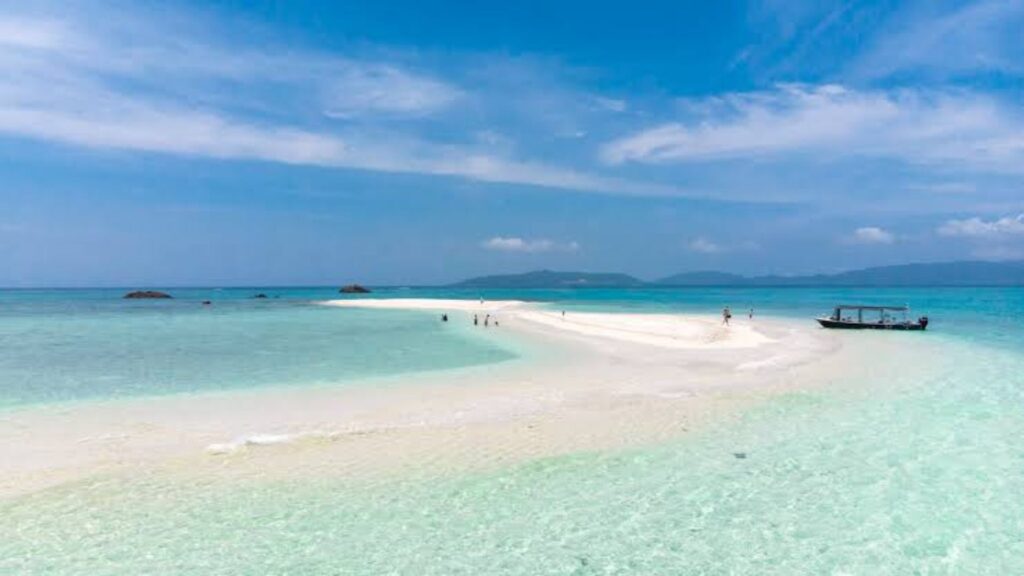
The Phantom Island (Hamajima)
A sandbar that appears only at low tide in the Sekisei Lagoon south of Ishigaki, surrounded by what is considered the finest coral reef system in the Yaeyama group. Access is by guided tour only, boat tours departing from Ishigaki or Kohama Island time their arrival to coincide with low tide, allowing visitors to walk on the sandbar and snorkel the surrounding reef before the tide returns and the island disappears again. The Sekisei Lagoon is home to Japan’s largest coral reef area, and the snorkelling around the Phantom Island sandbar covers reef of extraordinary colour and diversity.
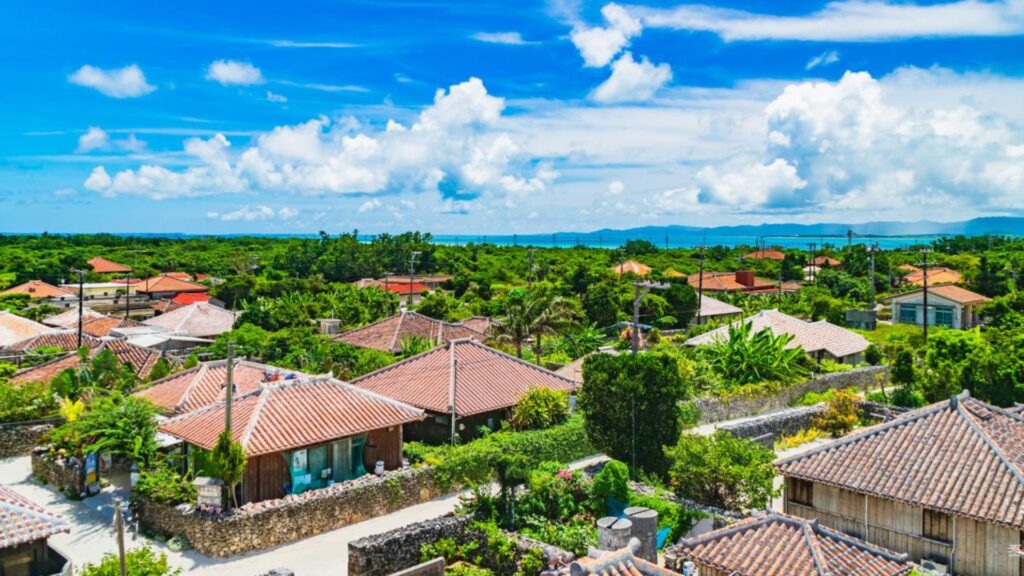
Taketomi Island – shallow reef snorkelling
Ten minutes by ferry from Ishigaki, Taketomi is a flat coral island best known for its preserved Ryukyuan village of traditional red-tile roofed houses, but the surrounding shallow reef is accessible by snorkelling from several beach points around the island and delivers excellent coral and tropical fish encounters in calm, clear water. The combination of cultural visit to the village and snorkelling from the island beach in a single day is one of the most satisfying day-trip combinations available from Ishigaki.
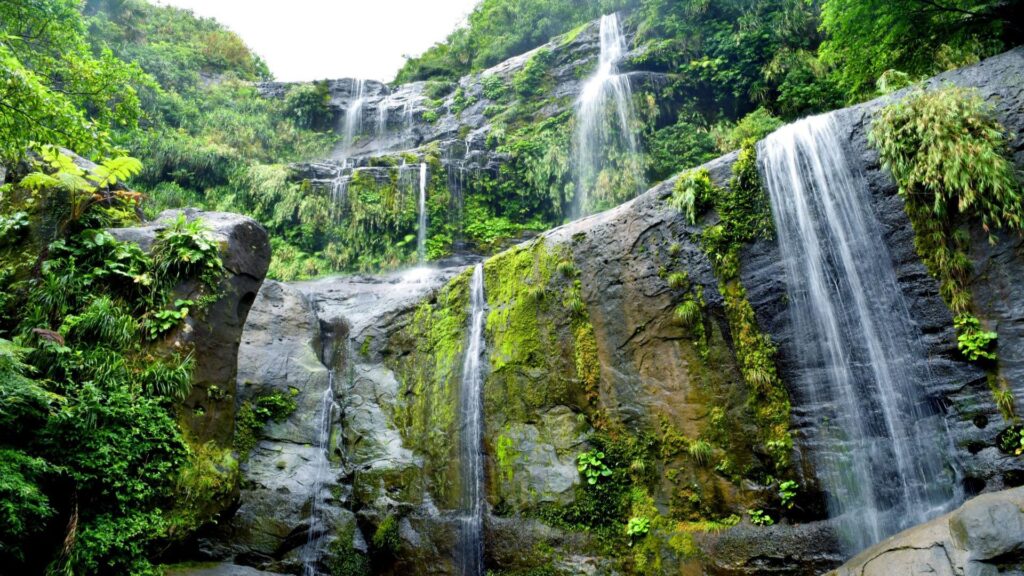
Iriomote Island – river and reef
Covered in subtropical jungle across 90 percent of its surface, Iriomote offers marine experiences unlike any other island in the group. Mangrove river kayaking, paddling into the jungle interior on rivers accessible only by shallow-draft kayak, with kingfishers overhead and clear river water reflecting the canopy above, is the defining Iriomote activity. The coastal reef around the island, less visited than Ishigaki’s dive sites, offers encounters with sea turtles, rays, and tropical fish in environments that feel genuinely remote.
The Pinaisara Waterfall hike, which follows a river through the jungle to Okinawa’s tallest waterfall before descending to the coast for snorkelling, is one of the finest combined land and water experiences available in the entire archipelago.
The main island: accessible water experiences
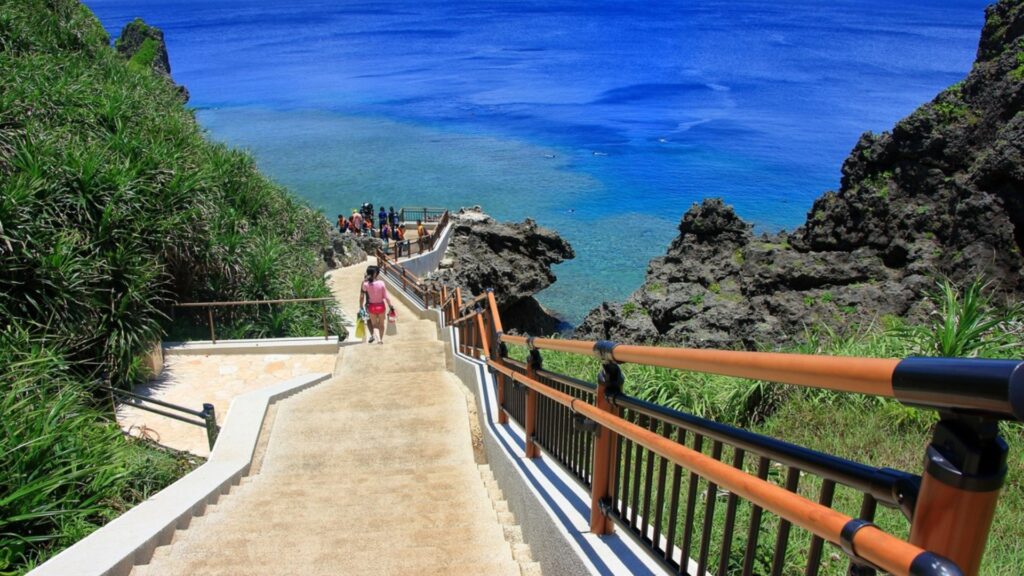
The Blue Cave, Cape Maeda
The most visited snorkel and dive site on the main island, and the one most achievable on a half-day from Naha. The Blue Cave is a submarine cave whose entrance, at around five metres depth, allows sunlight to refract through the water and create an electric blue illumination of the cave interior. The phenomenon is most dramatic on sunny mornings. The surrounding reef supports clownfish, parrotfish, and various tropical species accessible to snorkellers as well as divers.
The site is extremely popular, on peak summer mornings, the water around the cave entrance can be crowded. Choosing a guided morning tour that departs early, or visiting on a weekday, makes a significant difference to the experience. Book through GetYourGuide for English-speaking guides with free cancellation.
Cape Maeda reef
The broader reef around Cape Maeda, beyond the Blue Cave entrance, is accessible to snorkellers from the shore and offers more varied coral coverage than the cave itself. A mask, snorkel, and fins rented from the dive shops at the cape car park are all that is required. The reef begins within swimming distance of the rock shoreline and extends in several directions with varying depth and coral diversity.
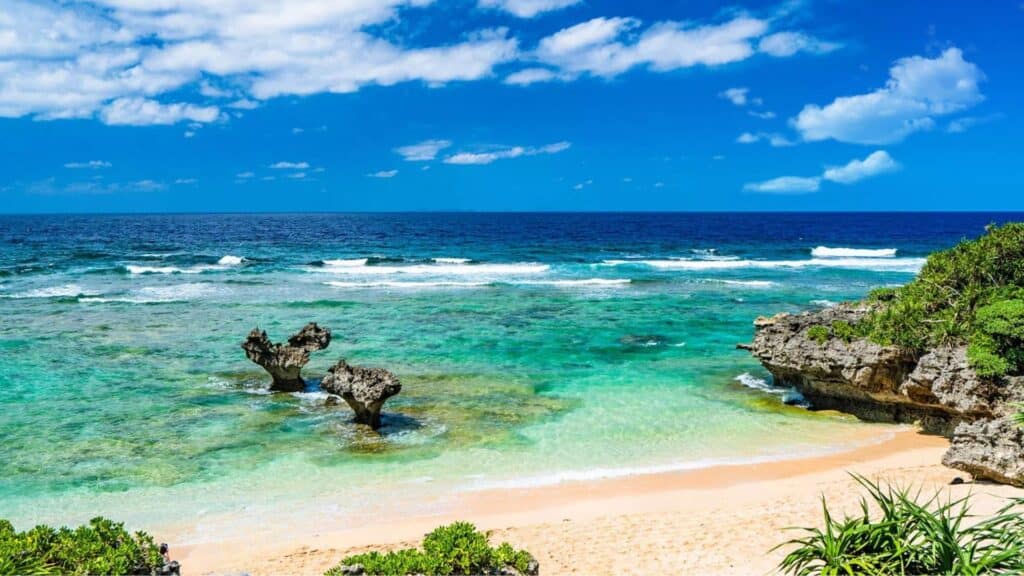
Kouri Island
Connected to the main island by a 1.9-kilometre bridge, Kouri’s beaches offer some of the clearest water accessible by car from the main island. Kouri Beach, white sand, turquoise water, sheltered by the island’s geography, is the main swimming beach and one of the better snorkelling points on the main island, with reef accessible from the beach edges. Less spectacular than the Kerama Islands but requiring no ferry.
Jellyfish season: what to know
Box jellyfish and other stinging species are present in Okinawan waters from approximately May to October, with August and September being the peak risk period. Most managed beaches on the main island and the outer islands install jellyfish nets during this period, creating safe swimming zones within the netted area.
Outside the nets, and on beaches without net protection, standard precautions apply, full-length rash guards are strongly recommended over swimwear during jellyfish season, and are widely available at dive shops and beach equipment rental throughout the islands.
The outer island beaches, Furuzamami, Aharen, Yonaha Maehama, all have jellyfish net systems during peak season. Check with your accommodation or local dive shop on arrival for the current net status at your specific beach.
Water temperature and dive conditions by season
| Season | Water temperature | Visibility | Conditions |
|---|---|---|---|
| Winter (Dec to Feb) | 19-22°C | Excellent | Wetsuit required. Humpback whale season. Uncrowded. |
| Spring (Mar to May) | 22-25°C | Excellent | Best overall season. Good visibility, warming water, fewer visitors. |
| Summer (Jun to Sep) | 27-30°C | Good to excellent | Peak season. Manta rays at Ishigaki. Jellyfish present. Typhoon risk from August. |
| Autumn (Oct to Nov) | 24-27°C | Excellent | Excellent visibility, warm water, thinning crowds. Best shoulder season. |
Snorkelling vs diving: which is right for you
Okinawa rewards both equally, but the choice of islands changes depending on which you prioritise.
For snorkellers: The Kerama Islands are the most rewarding destination in the archipelago. The coral begins at the waterline at Furuzamami and Aharen, sea turtles are reliably encountered, and the Kerama Blue means visibility is excellent without needing to descend below the surface. Miyako is the second choice, the water clarity is extraordinary and the Yabiji reef tour adds a dimension unavailable in the Keramas.
For certified divers: Ishigaki for Manta Scramble and the Yaeyama dive sites. Yonaguni for the underwater ruins (covered in the outer islands post). Kume Island for hammerheads and wreck diving. Miyako’s Irabu Island for cave and arch diving.
For beginners and non-swimmers: The Blue Cave on the main island with a guided tour. Kabira Bay glass-bottom boat. Kouri Island from the beach. All are accessible without prior swimming or diving experience.
Practical information
Rental equipment: Mask, snorkel, fins, and rash guards are available at dive shops throughout the islands, on Zamami, Tokashiki, Miyako, and Ishigaki as well as at Cape Maeda on the main island. A half-day rental costs approximately 1,000 to 2,000 yen.
Guided snorkel tours: Strongly recommended for first visits, particularly at sites like the Blue Cave where the cave entrance requires brief diving below the surface. English-speaking guides are available at all main sites. Book through GetYourGuide or Viator for verified operators with free cancellation.
Sun protection: The subtropical sun in Okinawa is significantly stronger than mainland Japan. Mineral-based sunscreen only at reef sites, chemical sunscreens damage coral and their use is increasingly restricted at protected reef areas. Many dive operators now provide reef-safe sunscreen or require its use. A rash guard covering the arms and shoulders is more effective than sunscreen for extended time in the water.
Getting to the outer islands: Kerama Islands by high-speed ferry from Naha’s Tomari Port (30 to 50 minutes depending on island). Miyako and Ishigaki by flight from Naha (45 to 55 minutes). Ferry schedules and flight availability change seasonally, book ahead during peak summer months when both ferries and flights fill quickly.
The complete Okinawa series
Everything you need to go properly:
- Okinawa: the complete guide – what it is, where it is, the history, the Blue Zone, the full 10-day itinerary
- Eating in Okinawa – champuru, soba, sea grapes, awamori, the longevity diet and where to experience it (coming soon)
- Where to stay in Okinawa – Hyakuna Garan’s Michelin Key clifftop ryokan to Kerama Island guesthouses (coming soon)
- The best tours and activities – humpback whale watching, Manta Scramble, Iriomote kayaking, the Phantom Island (coming soon)
- The outer islands – Kerama, Miyako, Yaeyama, Yonaguni and the mystery on the ocean floor
- Why Okinawa is the most extraordinary island group in Asia – the editorial case
Some links in this post are affiliate links. If you book through them, flight.now earns a small commission at no extra cost to you. Learn more here