
There is a building in Chengdu, China, where you can check in, change into pyjamas provided at the door, spend a full day moving between nine themed hot spring pools, seven saunas, a cave-themed library, two cinema rooms with beds instead of seats, a gaming lounge with PS5s, a mahjong room, a live music space, a fruit bar, and an all-you-can-eat snack station. Then sleep. Then have breakfast. Then do it again.
The price for all of this is roughly $35 to $50, depending on the package you choose.
The place is called Cheersum (technically the Cheersum Hotel, but calling it a hotel significantly undersells what’s happening inside). It sits within the New Century Global Center in Chengdu’s Tianfu New Area, one of the largest buildings on the planet by floor space. The spa occupies seven floors of it.
This is not a secret. It’s been discovered by Chinese social media for years, and in the last eighteen months has become a phenomenon on TikTok and Instagram, with travellers from Europe, Australia, the US, and Singapore reporting some variation of the same reaction: genuine disbelief that this exists, followed by genuine distress at having to leave.
What it actually is
The Cheersum spa belongs to a specifically Chinese wellness tradition: the shuǐliáo (water therapy) bathhouse, scaled up to levels that have no equivalent anywhere in the Western world.
The closest comparison most Western visitors reach for is “like a spa, but one you never have to leave.” The structure is designed so that every physical and social need is met within the building. You eat here, sleep here, bathe here, relax here, and entertain yourself here, all without stepping outside. It’s less a spa experience and more a parallel lifestyle, compressed into 24 hours.
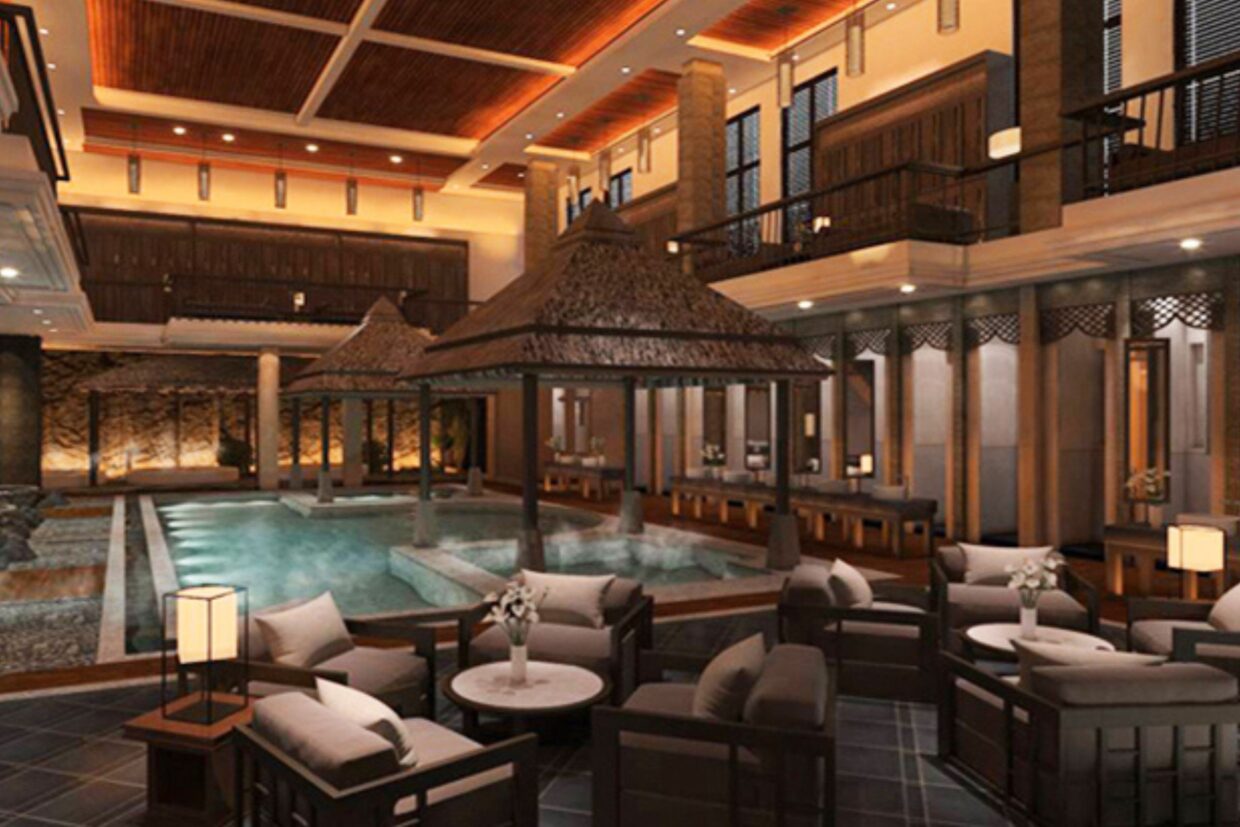
The key difference from a hotel is atmosphere: the pace is unhurried, the lighting is low and warm, staff are present and attentive without being intrusive, and the entire place is built around the assumption that you are here to do nothing at full intensity.
The facilities
The facility list is the part that consistently stops people mid-scroll when they encounter Cheersum for the first time:
Water facilities: Nine themed hot spring pools (themes and temperatures vary, but include mineral pools, salt pools, and cooler plunge options). Separate areas for men and women in the bathing sections. Multiple hot tubs and hydrotherapy stations.
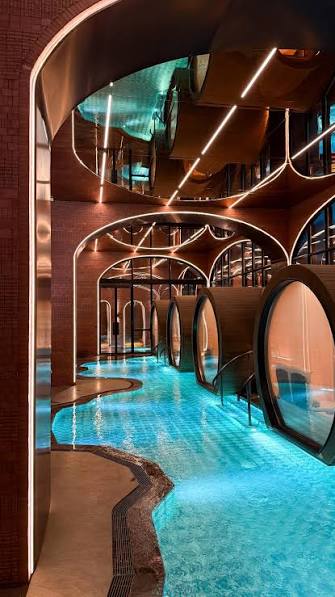
Saunas: Seven saunas across a range of temperatures, from around 40°C to over 50°C. Dry sauna, steam rooms, and salt rooms are all included in the base entry.
Sleep: Shared sleeping areas with individual pods or reclining chairs, plus private rooms available at additional cost. Blankets and pillows are provided. Several guests report sleeping better here than in conventional hotels.
Entertainment: Two cinema rooms with beds instead of seats, currently rotating films. PS5 gaming rooms. Mahjong rooms and private poker rooms. A cave-themed library. A live music space. Karaoke rooms (usually available at additional cost). Pool table room and arcade games.
Food and drink: An all-you-can-eat fruit bar and unlimited soft drinks, milk tea, snacks, and ice cream are included in the base entry price. A full restaurant with Japanese and Chinese cuisine, plus a buffet covering lunch, dinner, and late-night snacks, is available as a paid upgrade at generally around $30 extra per person, and overwhelmingly described as worth it.
Wellness extras (additional cost): Full-body massage, body scrub, ear cleaning, foot massage, facial treatments, and nail services. Prices are dramatically lower than Western equivalents. A one-hour full-body massage typically runs $15 to $25 extra.
What’s provided: On arrival, guests swap street clothes for spa-provided shorts, T-shirt, slippers, and sandals. Locker rooms include shampoo, conditioner, body wash, hair dryers, and all standard amenities. Towels are included throughout.
The experience in practice
Most visitors describe a similar arc.
Arrival involves removing shoes at the entrance, receiving slippers, and being guided through check-in by staff who are consistently described across reviews as exceptionally attentive. The level of service surprises many Western visitors given the price point. Changing rooms lead into the main facility.
The first hour tends to involve some confusion: the scale of the place, and the number of options available, takes time to absorb. Once orientation settles, most guests find a rhythm. Typically this means cycling between pools and saunas, eating fruit, wandering into the cinema for an hour, trying a treatment, eating again, and gradually surrendering to the pace of the place.
The quality that recurs most consistently in reviews is the feeling of complete absence of time pressure. There is no checkout clock in the conventional sense. You have the full 24 hours, and nobody is counting them on your behalf.
“I honestly forgot what day it was by hour six. In the best possible way.”
Weekday visits are strongly recommended. A Monday morning visit at 10am proves significantly calmer than weekends, allowing full enjoyment of the experience without the bustle of peak crowds.
The price
This is where Cheersum defies expectation most dramatically:
- Base 24-hour entry: ~$35 to $50 USD (approximately £30 or €45 to €50, depending on current rates)
- Includes: All pools, saunas, sleeping areas, entertainment rooms, fruit bar, unlimited snacks and soft drinks, spa clothing, towels, and all standard amenities
- Full meal package upgrade: ~$30 extra per person, covering unlimited lunch, dinner, and late-night buffet
- Treatments: Massage from ~$15; body scrub from ~$15; full packages available
- Optional upgrades: Private sleeping room, karaoke, additional treatments
The total spend for a genuinely comprehensive 24-hour experience (pools, saunas, food, one massage, snacks) typically lands around $70 to $90 per person. For a full day and night of this level of facility and service, that figure consistently produces disbelief in travellers arriving from Western price contexts.
What the 24-hour format actually means
The 24-hour pass is not a gimmick. It’s the entire point.
Western spa culture operates on appointment slots: an hour here, a treatment there, a day pass that expires at 6pm. Cheersum removes the clock entirely. Guests arrive when they arrive, sleep when they sleep, eat when they eat, and leave when they feel ready within the 24-hour window. Several visitors report staying the full duration not because they planned to, but because there was simply no compelling reason to leave earlier.
For travellers with long layovers in Chengdu, the 24-hour structure makes particular practical sense. It functions as accommodation, entertainment, meals, and wellness all in one, often at a lower combined cost than a hotel room alone.
It is also, for visitors arriving from places where communal bathing is not a cultural norm, a genuinely new experience. The bathing areas follow traditional communal spa culture, which is standard in China, Japan, and Korea and is considered entirely normal. First-time visitors are advised to read up on communal bathing etiquette before arriving. Most find it unremarkable within the first thirty minutes.
How to get there
Cheersum is not easy to find on Western mapping apps. This is the most consistent practical complaint across all reviews, and worth taking seriously before you go.
Address: Inside the New Century Global Center, Tianfu New Area, Chengdu. The building says CHEERSUM on the exterior.
On Chinese map apps: Search 浅深 (Qiǎnshēn) on Amap or Didi, which is the most reliable way to get an accurate pin. On Didi it may appear as “Simple Deep Vacation Hotel.”
By metro: Jincheng Plaza Station on Line 1 is the closest metro stop.
Booking: Walk-ins are accepted and common. For peak weekend visits, booking via Dianping (China’s equivalent of TripAdvisor) is recommended. Search 浅深水疗 to find the listing. The interface is in Chinese; Google Translate’s camera function handles it adequately.
Language: English is limited. The following phrase covers most booking and entry needs:
“你好,我想预约浅深水疗的服务,请问可以预订吗?” (Nǐ hǎo, wǒ xiǎng yùyuē Qiǎnshēn shuǐliáo de fúwù, qǐngwèn kěyǐ yùdìng ma?) “Hello, I want to book a service at Qianshen Spa. Can I make a reservation?”
Practical notes before you go
Bring: A small amount of cash in Chinese yuan. WeChat Pay or Alipay are the dominant payment methods and Western cards are not reliably accepted. Also bring any personal skincare products you’re particular about, as standard amenities are provided but branded products are your own call.
Don’t shave immediately before visiting. The mineral content in some pools stings fresh-shaved skin.
Phone signal and wifi are available throughout the building, though the point is arguably to use them less.
Solo female visitors consistently rate Cheersum highly for safety and comfort. The staff presence is attentive, the environment is well-lit and maintained, and multiple solo female travellers describe it as among the most comfortable solo wellness experiences they’ve had anywhere.
Children are welcome, though the environment is quiet-focused rather than child-entertainment-focused.
The bigger picture
Cheersum is not unique in China. 24-hour spa culture (sometimes called zuòyù or the 洗浴中心 tradition) exists across the country in various forms, from mid-range to luxury. Chengdu alone has several comparable facilities. Beijing and Guangzhou both have well-regarded equivalents.
What Cheersum represents, for a Western visitor encountering it for the first time, is a fundamentally different answer to the question of what wellness looks like. Not a treatment booked weeks ahead. Not a day pass that expires at 6pm. Not a single modality, a single therapist, a single hour. Instead: the entire infrastructure of rest, recalibrated around the assumption that you might want to stay longer than anyone in the West has been told is reasonable.
Most people who go stay longer than they planned. Almost none of them regret it.
The essentials
- Location: New Century Global Center, Tianfu New Area, Chengdu, China
- How to find it: Search 浅深 on Amap or Didi
- Base entry: ~$35 to $50 for 24 hours
- Full package (with meals): ~$70 to $90 per person
- Best day to visit: Monday to Thursday for a calmer experience
- Arrive: With an open schedule and no reason to rush back