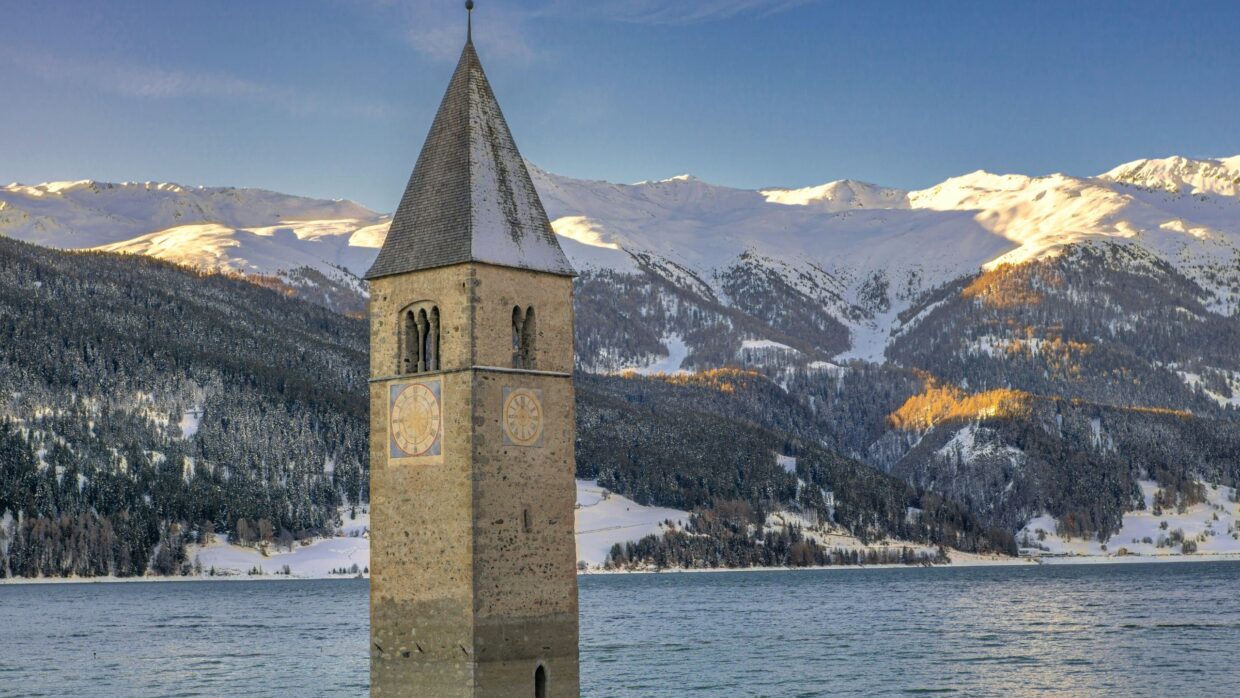
There is a photograph that stops people mid-scroll every time it appears. A single medieval bell tower rising from the centre of an Alpine lake, surrounded by water on all sides, its stone spire pointing at the mountains. No church. No village. Just the tower, alone in the water, as if the lake simply decided one day to swallow everything else and leave this one thing behind as a reminder.
The lake is Lake Resia in South Tyrol, northern Italy. The tower is the 14th-century bell tower of the Church of Santa Caterina d’Alessandria, built in 1357. And the reason it is standing in water instead of on land is not a natural disaster, an act of God, or a geological event. It is a decision made by a government in 1950 to flood an entire village in the name of hydroelectric power.
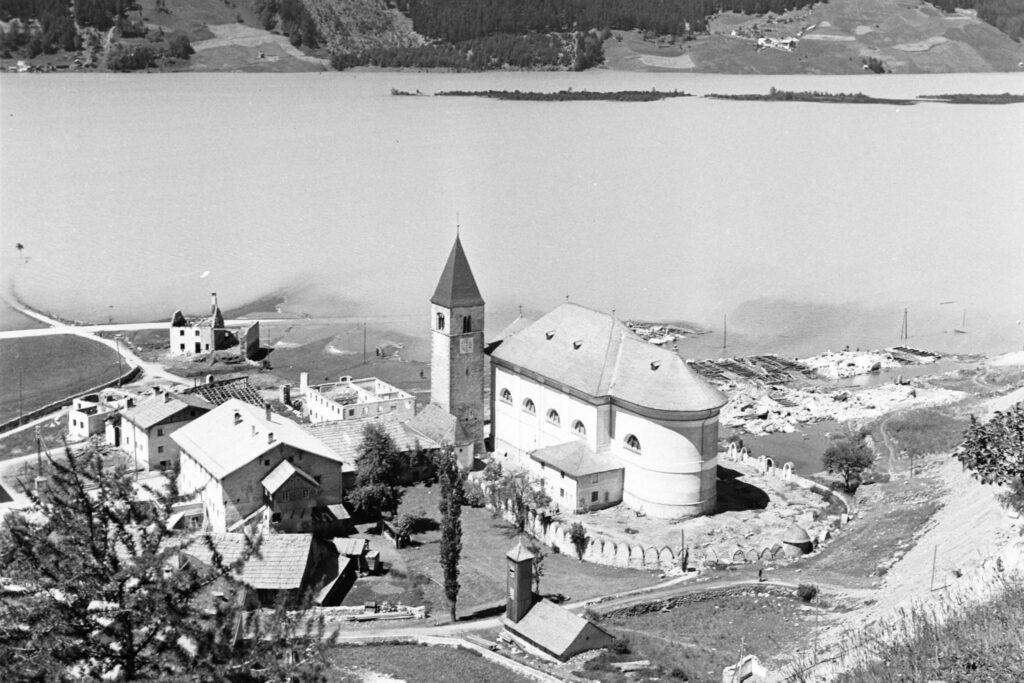
The village was called Curon Venosta. Approximately 1,000 people lived there. They protested, petitioned, appealed to local and national government, and sent a plea to the Pope. The water rose anyway. The bells were removed from the tower on July 18, 1950. The rest of the village was demolished with explosives before the flooding, because rooftops and walls would have been dangerous to boats on the new lake. The bell tower was left standing. Nobody has ever fully explained why.
It has been standing in the water ever since.
The history
The idea of flooding the Venosta Valley was not born in a democratic Italy. The plans were first drawn up in the 1930s under Benito Mussolini’s fascist government, which had specific reasons for wanting to transform this particular corner of the country. South Tyrol had been part of the Austro-Hungarian Empire until 1919, when Italy annexed it at the end of World War One. Most of the population spoke German, not Italian, and the Mussolini government pursued aggressive Italianisation policies throughout the 1930s: forcing German-speaking children to attend Italian-language schools, banning German place names, and systematically replacing the cultural identity of the region.
Flooding the valley was, in this context, not purely an energy decision. It was also the erasure of a German-speaking community’s landscape, history, and sense of place. The plans were delayed by the outbreak of World War Two, which perhaps saved the village for a decade. When construction resumed after 1945 under the new democratic Italian republic, the villagers of Curon hoped the new government would listen differently than the old one had. It did not.
The Montecatini industrial company received the government mandate to proceed. The project merged three pre-existing natural lakes: Lake Resia, Lake Curon (known locally as Mittersee), and Lake San Valentino alla Muta, creating a single artificial reservoir holding 120 million cubic metres of water. To do this, the water level had to rise approximately 22 metres. Everything below that line would disappear.
The residents of Curon and the neighbouring village of Arlung were offered compensation and relocated to a newly built settlement nearby, also called Curon Venosta, constructed on higher ground above the future waterline. The compensation was widely described as derisory. Nearly half the displaced population refused to stay in the area at all, emigrating to other parts of Italy, to South America, and to Australia.
Those who stayed watched the water rise. One resident, Theresa Theiner, whose parents had owned the Traube Post inn in the old village, later recalled that the family’s St Bernard dog continued to swim back to the area of the inn for years after the flooding, unable to understand that the place it had lived was gone. The inn was 22 metres underwater. The dog kept going back.
On the day the water reached its final level, it covered 677 hectares of cultivated farmland, the foundations of 163 homes, the floor of the church where generations of families had been baptised, married, and mourned, and the graves of the old cemetery.
The bell tower remained above the waterline by a matter of metres. The bells had already been removed. The tower stood alone in the new lake, exactly as it stands today.
The legend of the bells
Local people have long told a story about the old bells. They were removed before the flooding, but some residents claim that on quiet nights, particularly in winter, you can still hear bells ringing from beneath the water. There is no mechanical explanation for this. It is almost certainly the wind moving across the surface of the lake and producing a resonance through the old stone, or simply a sound that winter silence allows the imagination to complete.
But the story persists, because some losses are too large to sit in silence, and because the specific image of a submerged bell tower ringing from the bottom of an Alpine lake is exactly the kind of image a community needs to hold onto when something irreplaceable has been taken from it.
The legend became so attached to the place that Netflix used it as the premise for a 2020 supernatural thriller series titled simply Curon, in which the bell tower and the lake serve as a portal between worlds. The series introduced a new generation of visitors to the story of the old village, though it dramatised the supernatural dimension rather than the historical one. The history, as it turns out, requires no embellishment.
What the tower looks like across the seasons
The bell tower is the same structure in all seasons, but the lake around it transforms the image completely.
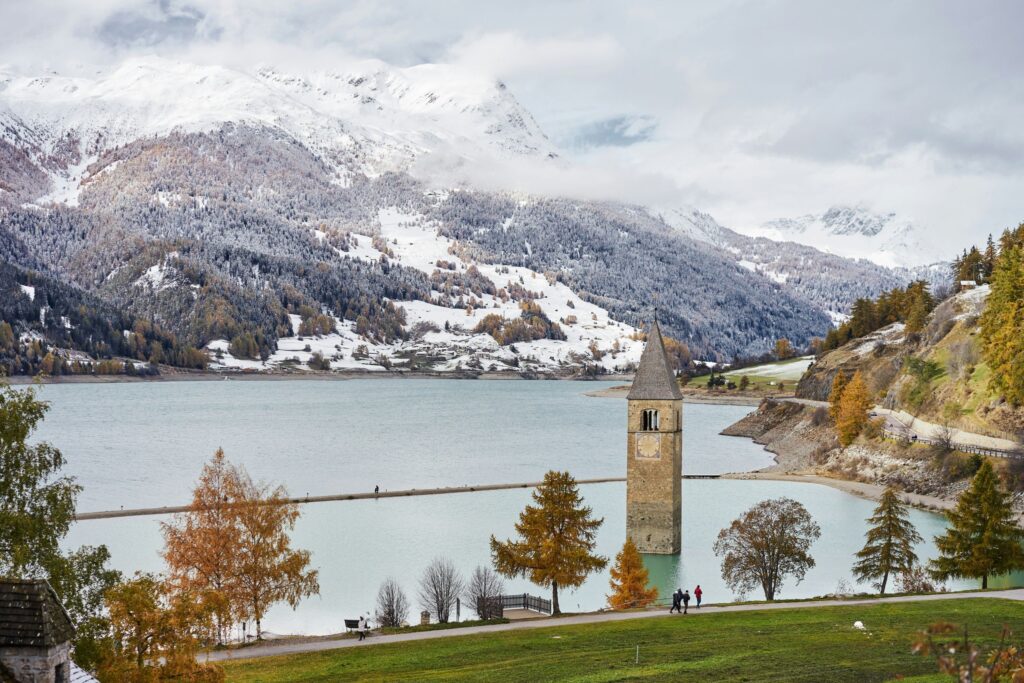
In summer, the tower rises from clear green-blue Alpine water, with the Ortler Alps and the Ötztal Alps rising behind it. The lake stretches nearly four miles and is surrounded by walking and cycling trails. The water temperature averages 14 degrees Celsius, which is too cold for casual swimming but not for dedicated wild swimmers.
In autumn, morning mist sits on the surface of the lake and the tower disappears into it from the waist up, producing a particularly atmospheric image that is the one most landscape photographers come specifically to capture.
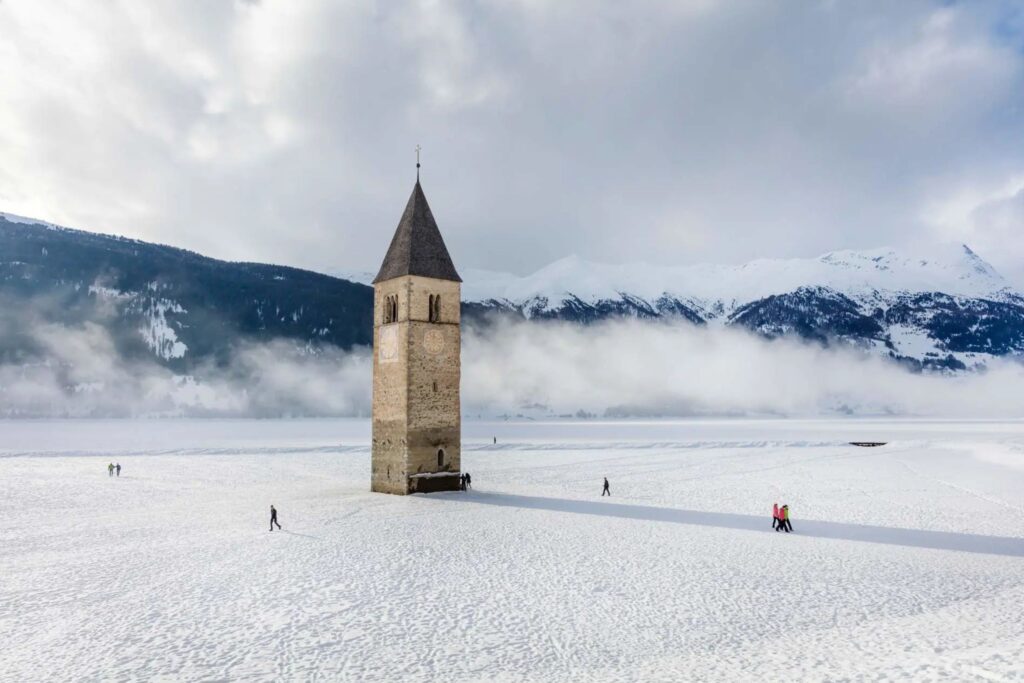
In winter, Lake Resia freezes. The ice is thick enough to walk on in cold years, and when it does, something remarkable happens: visitors can walk directly across the frozen lake to the base of the tower and stand beside it. Standing at the foot of the tower in winter, surrounded by Alpine ice with the frozen lake stretching in every direction and the mountains above, with 22 metres of submerged village beneath your feet, is one of those experiences that resists easy description.
In spring, the ice thaws and the tower is briefly surrounded by chunks of floating ice as the lake shifts back to water.
What to see and do
The bell tower itself is visible from the eastern shore of the lake, directly across from a large parking area (navigate to Campanile di Curon Venosta Vecchia). There is no fee to park. The view from the shore is the classic image most visitors come for: tower, water, mountains.
The Church of Sant’Anna sits on a hill above the lake and offers the best elevated panoramic view of the tower and the full extent of Lake Resia. The walk up is short and the view rewards the effort significantly. This is the shot that shows the tower in context with the surrounding landscape rather than simply as an isolated structure.
The Alta Val Venosta Museum in the new village of Curon Venosta is the most important stop for understanding what happened here. A small museum with extraordinary photographic documentation showing life in the old village before and after the flood: period photographs of the residents abandoning their homes, of streets already half-submerged, of the tower standing alone as the water reached its final level. Some visitors describe the museum as the most emotionally affecting part of the whole visit. It is open primarily in summer; confirm opening hours before visiting.
The new Church of Santa Caterina in the rebuilt village of Curon Venosta was completed in 1951, the year after the flooding, as the community’s first act of rebuilding. A new white bell tower rises above the village in deliberate echo of the original, visible against the Ötztal Alps. The foundation was laid on May 29, 1950, while the old village was still being demolished.
Walking around the lake takes approximately four hours at a leisurely pace. The cycling path following the ancient Via Claudia Augusta route runs through the area and connects to Merano, making Lake Resia a natural stage on a longer cycling itinerary.
Winter ice walking to the tower base is possible in cold years when the ice is thick enough. Ask locally before attempting this; conditions vary significantly between years and from day to day within the season. The lake does not freeze uniformly.
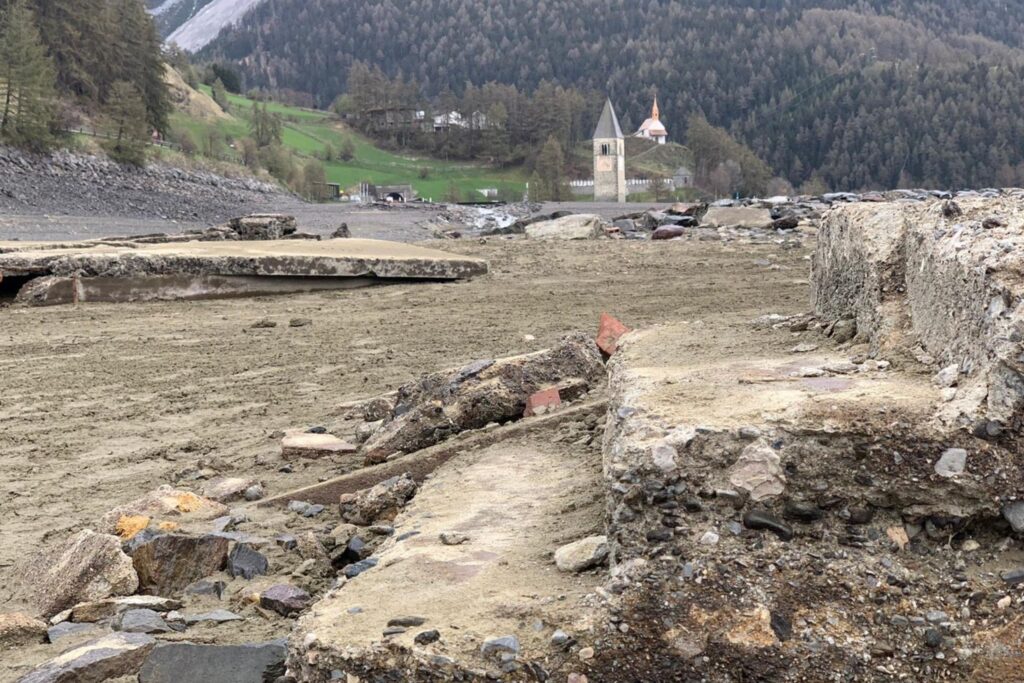
The 2021 partial draining of the lake for dam repairs briefly exposed the ruins of the old village for the first time since 2009: foundations, walls, paved roads, and the skeleton of the old settlement visible in the mud for a matter of weeks. Former residents and their descendants came to look. Some were seeing what remained of their childhood homes for the first time in 70 years. The lake has since been refilled to its normal level. If further maintenance work creates another draining event, it will be announced through local and regional news.
Getting there
Lake Resia sits in the Val Venosta (Vinschgau in German) in South Tyrol, very close to the borders with Austria and Switzerland. It is approximately 2 kilometres south of the Resia Pass.
By car: The most practical approach. From Bolzano, take the SS38 northwest through the Val Venosta. The drive takes approximately 1.5 to 2 hours. The lake appears suddenly around a bend in the road, which is the best possible introduction. From Innsbruck in Austria, the approach via the Reschenpass road takes approximately 1 hour. From Munich, approximately 2.5 hours.
By public transport: The Val Venosta Railway (Vinschgerbahn) runs from Merano to Malles Venosta, with Malles being the closest station to Lake Resia at approximately 8 kilometres. Local buses connect Malles to Curon Venosta. Journey time from Merano is approximately 1.5 hours by train.
By bike: The Via Claudia Augusta cycling route passes through the area and is one of the finest long-distance cycling routes in the Alps. Arriving by bike, through the Val Venosta corridor, is the most rewarding way to approach the lake.
When to go
Every season offers a different version of the same image, and the choice depends on what you want from the visit.
Summer (June to September) is the most accessible and the most visited. The lake is navigable by kayak and paddleboard, walking and cycling trails are fully open, and the Alta Val Venosta Museum operates its full schedule. Accommodation in Curon Venosta and nearby Malles is available but should be booked ahead in July and August.
Autumn (September to November) is the most atmospheric for photography. Morning mist on the water, the changing colour of the surrounding forest, and significantly fewer visitors than summer make this the season most landscape photographers prefer.
Winter (December to March) is the most dramatic and the most unusual. When the lake freezes solidly enough to walk on, the experience of crossing the ice to the tower base is unlike anything else the lake offers. Winter also brings skiing in the surrounding area, with the Watles ski resort nearby.
Spring (April to May) brings the ice melt and the return of clear water, with snow still visible on the surrounding peaks and the valley beginning to turn green.
Where to stay
The rebuilt village of Curon Venosta has a small selection of hotels and guesthouses. The surrounding area extends to Malles Venosta, Glorenza (one of the smallest walled towns in Europe, 7 kilometres away and worth a separate visit), and the broader Val Venosta.
Hotel Seeblick in Curon Venosta sits directly above the lake with tower views from several rooms. Mid-range, family-run, and consistently recommended for the specific combination of location and personal service.
Pension Vinschgerhof in Curon Venosta is a simpler, more budget-friendly option close to the lake with basic but comfortable rooms.
For broader accommodation options, Malles Venosta has more variety and is 20 minutes’ drive from the lake, making it a practical base for a multi-day visit to the valley.
What to eat and drink
South Tyrol is one of the most interesting food regions in Italy: a hybrid of Italian and Tyrolean culinary traditions that produces a cuisine unlike anywhere else in the country.
Schlutzkrapfen are the regional pasta: half-moon shaped, filled with spinach and ricotta, served with brown butter and Parmesan. The South Tyrolean version is lighter and more delicate than similar pasta from further south.
Speck is the region’s answer to prosciutto: a dry-cured, lightly smoked ham that is genuinely different from any other Italian cured meat. Available in every local shop, deli, and restaurant.
Vinschger Paarl is a regional flatbread made with rye flour and flavoured with fenugreek and caraway, specific to the Val Venosta and found almost nowhere else in Italy.
South Tyrolean wines from lower in the valley (the Alto Adige DOC zone) include some of Italy’s finest Pinot Grigio, Gewurztraminer, and Lagrein. Local restaurants in Curon Venosta and Malles carry wines from producers in the lower valley.
Local restaurants include the Grillhof in Curon Venosta for traditional South Tyrolean cooking, and several Gasthäuser (guesthouses with dining rooms) in the valley that serve lunch to walkers and cyclists passing through.
The broader context
Curon was not the only community in the region to be flooded for infrastructure in the 20th century. In the nearby Val Senales, the village of Karthaus was partially submerged to create Lago di Vernago, also in the 1950s. Across Europe, hundreds of communities were displaced by dam construction throughout the mid-20th century as governments prioritised postwar industrial and energy infrastructure over established communities.
What makes Curon’s story different, and what has made the bell tower one of the most powerful symbols in Italian culture, is the specificity of what survived. The tower was not saved deliberately. It was simply left behind when everything else was destroyed. And because it was left, it has spent 75 years becoming the most visible monument to the community that was removed, more powerful as an accidental remnant than any intentional memorial could have been.
The descendants of the families who were displaced still live in the valley. Some of them visit the tower regularly. Some of them, particularly the older generation, remember the old village, or remember the stories their parents told about it. Some of them were the children watching from the hillside as the water rose over the streets where they had walked to school.
The dog swimming back to the inn is the detail that stays. The water covered it 75 years ago. The dog kept going back anyway, because it didn’t understand that the place it knew was gone.
The essentials
- Location: Curon Venosta, Val Venosta, South Tyrol, northern Italy
- Nearest city: Bolzano (1.5 to 2 hours by car); Innsbruck, Austria (1 hour)
- Nearest train station: Malles Venosta on the Val Venosta Railway (8km from the lake)
- Parking: Free large car park directly opposite the tower (Campanile di Curon Venosta Vecchia)
- Best viewpoint: Church of Sant’Anna on the hill above the lake
- Museum: Alta Val Venosta Museum, Curon Venosta (open primarily summer)
- Winter ice walking: Possible in cold years; check local conditions before attempting
- Best season: Autumn for photography; winter for the ice; summer for full access
- Pairs well with: Glorenza walled town, Val Senales, cycling the Via Claudia Augusta, Bolzano and the Dolomites
Some links in this post are affiliate links. If you book through them, flight.now earns a small commission at no extra cost to you. Learn more here